
A complete guide to the ferries between Onomichi and Mukaishima, the starting point of the Shimanami Kaido. Learn about routes, fares, schedules, and how to board with your bicycle.
Hi, I’m Yuki KAWAI — a touring cyclist based along the Shimanami Kaido. Having cycled this route more than 300 times, I created this site to share practical, experience-based tips for anyone planning a cycling trip here. I hope it helps you make the most of one of Japan’s most beloved cycling destinations.
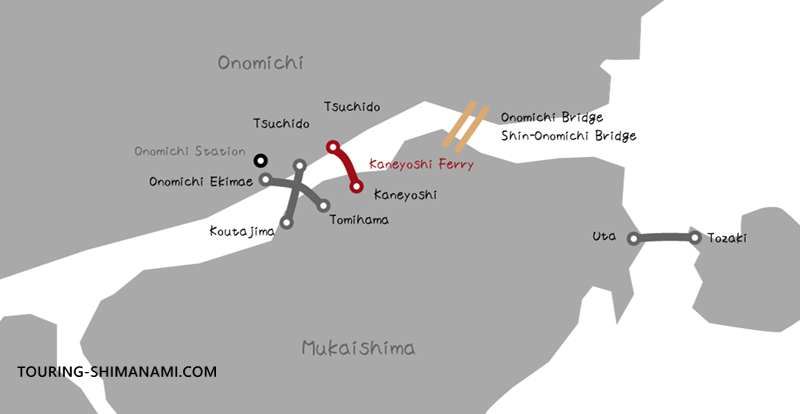
As previously announced, the Fukumoto Ferry — one of the three ferries between Onomichi and Mukaishima — ceased operations at the end of March 2025. The Onomichi Channel is now served by two active routes: the Ekimae Ferry and the Kaneyoshi Ferry.
The Starting Point of Shimanami Kaido
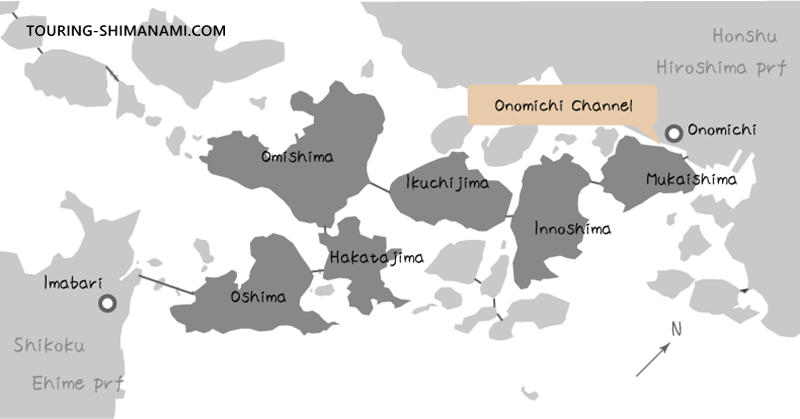
Shimanami Kaido is the road network connecting Onomichi City (Hiroshima) on Japan’s main island of Honshu with Imabari City (Ehime) on the island of Shikoku. The route winds through the Geiyo Islands of the Seto Inland Sea and is notable for being accessible not only by car via expressway, but also by bicycle, moped, and on foot.
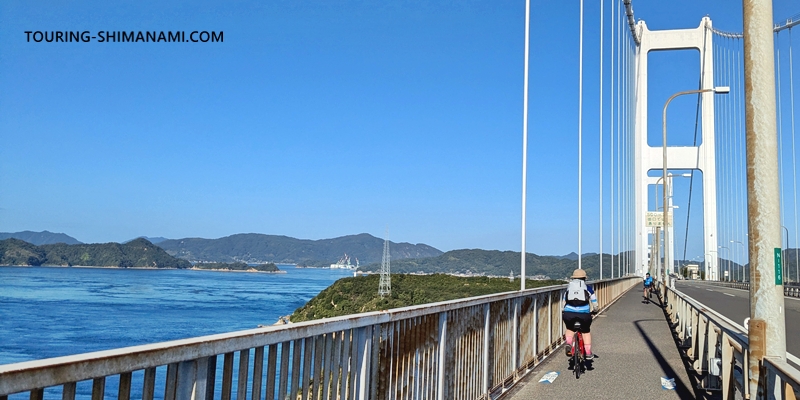
Cyclists in particular benefit from a well-developed infrastructure of rental bike services, rest stops, and the famous Blue Line — a painted guide on the road surface that leads the way from one end to the other. Both seasoned cyclists and first-time riders enjoy leisure cycling along this route.

Designated as a National Cycle Route, Shimanami Kaido draws visitors from around the world and is widely regarded as one of Japan’s premier cycling destinations. On this page, I’d like to focus on the Onomichi area on the Hiroshima Prefecture (Honshu) side of the route — specifically the somewhat exceptional part of the journey where cyclists take a ferry rather than a bridge.
The Onomichi Channel between Onomichi and Mukaishima
When cycling Shimanami Kaido, the Onomichi Station area in the former city center serves as the start or finish point on the Honshu side.
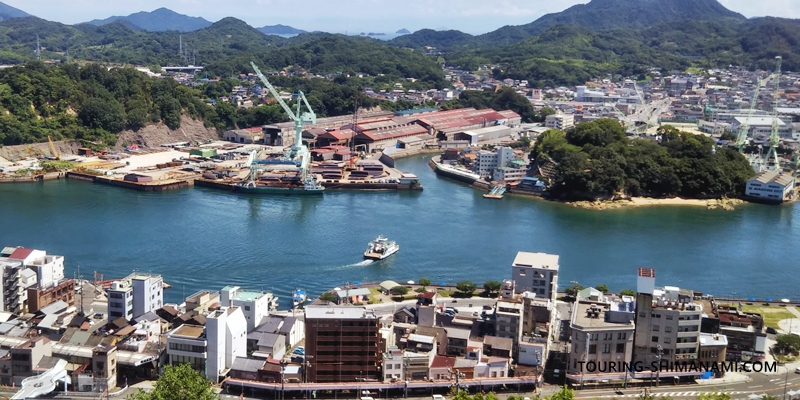
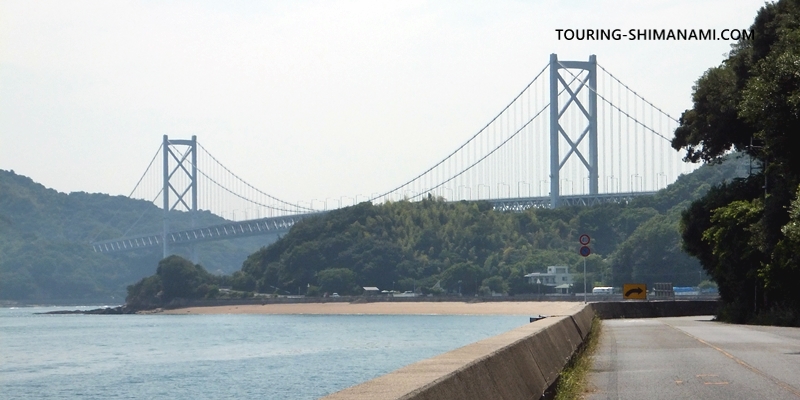
From here, cyclists head to Mukaishima, the first island on the route. Between Onomichi and Mukaishima lies the Onomichi Channel, a narrow strait spanned by two bridges: the Shin-Onomichi Bridge and Onomichi Bridge.
The Shin-Onomichi Bridge is part of the Nishiseto Expressway (the main Shimanami Kaido highway) and is closed to cyclists. Onomichi Bridge is a general road with no legal restriction on cycling, but it has no dedicated cycling lane and the road shoulders are very narrow, making it not recommended for cyclists.
Taking the Ferry Is the Recommended Way
For this reason, cyclists are strongly encouraged to use one of the local ferries (tosen) to cross the Onomichi Channel rather than attempting Onomichi Bridge.
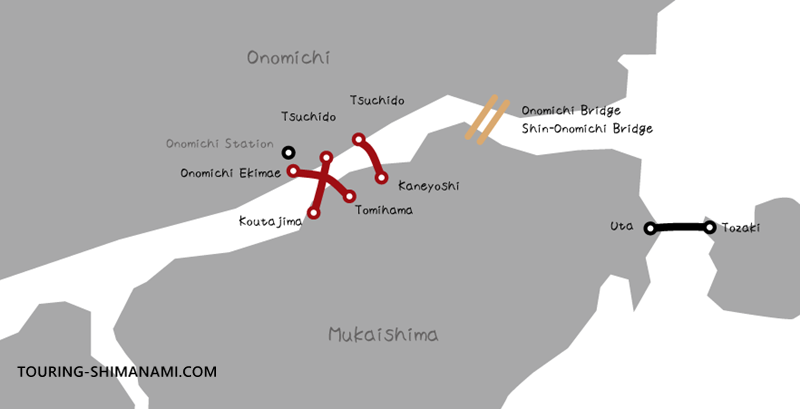
This is a somewhat “exceptional” part of Shimanami Kaido — instead of a bridge, you take a ferry. If you don’t know about this in advance, you might find yourself searching for a non-existent cycling lane entrance to Onomichi Bridge and wandering around in confusion.
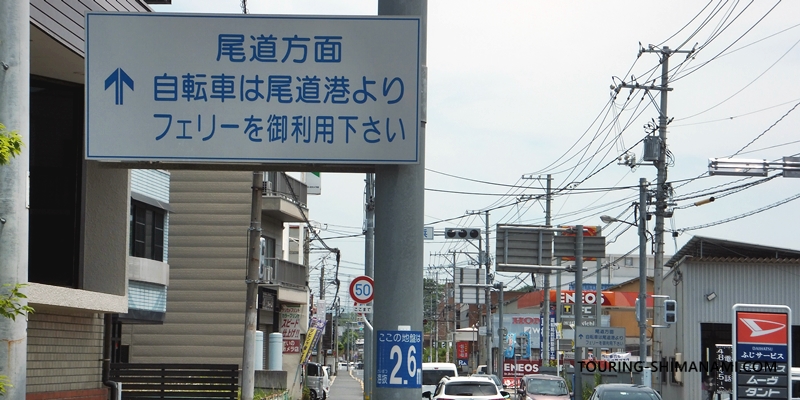
Signage at the station, tourist pamphlets, and the Blue Line painted on the road all direct cyclists toward the ferry boarding points. Whether you’re cycling or walking, please use the ferry to cross the Onomichi Channel. As mentioned above, Onomichi Bridge has narrow shoulders and obstacles on its walkway, making it both dangerous and frustrating to cross.
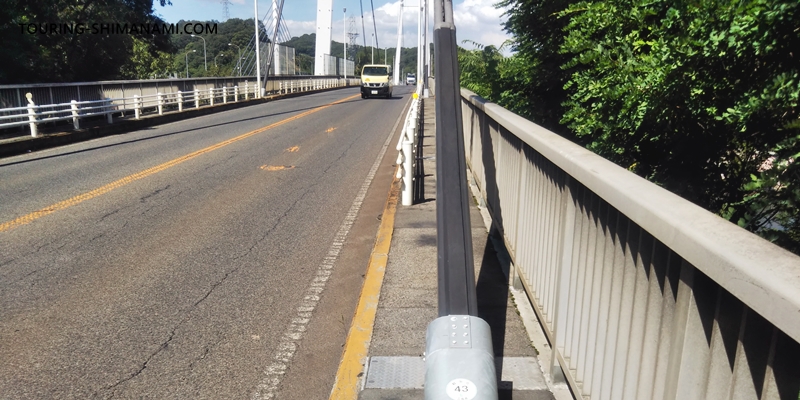
Cars and motorcycles, on the other hand, can use Onomichi Bridge. Vehicles authorized to use expressways can also cross via Shin-Onomichi Bridge on the Nishiseto Expressway. In either case, both routes involve a detour from the Onomichi Station area, so even local residents often use the ferry.
- Why cyclists should take the ferry to Mukaishima instead of using Onomichi Bridge
- Fares and vehicle-carrying capabilities of each ferry route
- Boarding point locations and how to board each ferry
Some of these ferry routes are operated by vessels that can also carry cars and motorcycles.
Let me walk you through the differences between the three ferries that connect Onomichi and Mukaishima!
AD (Google AdSense)
How the Three Ferries Differ
The Routes between Onomichi and Mukaishima
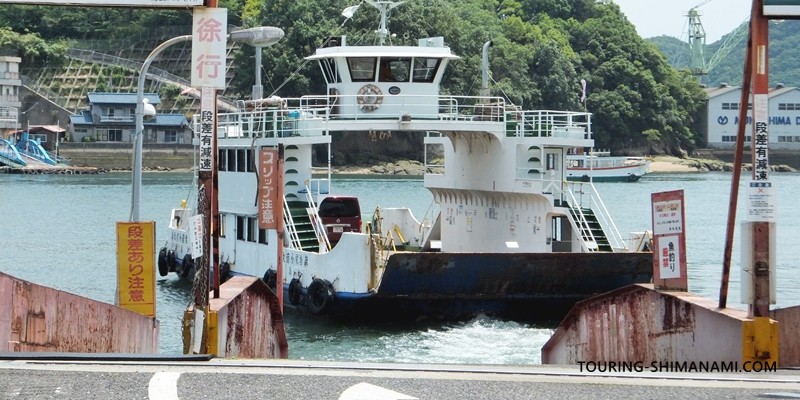
As mentioned above, there are (or were) three ferry routes between central Onomichi and Mukaishima. At its peak, there were as many as nine routes, but the number has dwindled following the construction of the bridges. Even so, these remaining ferries continue to serve as an essential transportation link for local residents — not just tourists — and see heavy use throughout the day. During school commuting hours, they fill up with students.
Moving from west to east along the Onomichi waterfront, you’ll find the boarding points for the Ekimae Ferry, the Fukumoto Ferry, and the Kaneyoshi Ferry, each slightly apart from the others. The Ekimae Ferry and the Fukumoto Ferry cross the Onomichi Channel on intersecting paths, landing at slightly different spots on Mukaishima. Each crossing takes around three to five minutes.
| Ferry | Ekimae Ferry (Station Front Ferry) | Kaneyoshi Ferry (Onomichi Ferry) | Fukumoto Ferry |
|---|---|---|---|
| Route | Ekimae ↔ Tomihama | Tsuchido ↔ Kaneyoshi | Tsuchido ↔ Kouta |
| Notes | Cyclists following the Blue Line from the Imabari side will be guided to this ferry — it’s the standard route for Shimanami Kaido cycling. | A small ferry that has served as a filming location for movies and TV dramas. It is the furthest boarding point from Onomichi Station. | [NOTICE] The Fukumoto Ferry was discontinued at the end of March 2025. |
Which Vehicles Each Ferry Can Carry
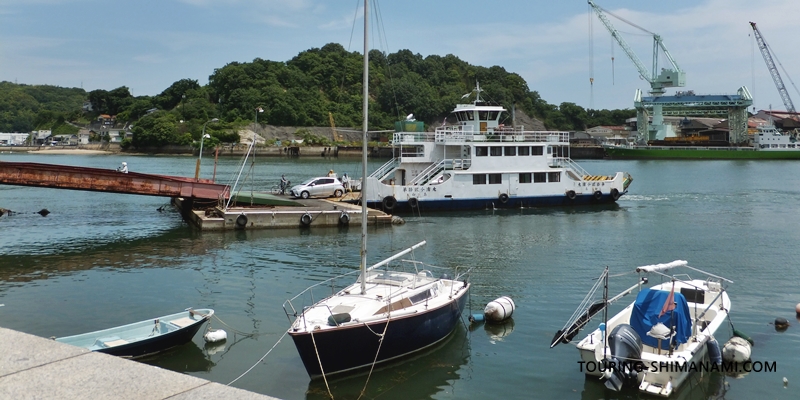
All three ferry routes between Onomichi and Mukaishima accept bicycles, so all three can be used for Shimanami Kaido cycling. Mopeds and scooters under 125cc are also accepted on all three routes. Motorcycles 125cc and above, as well as cars, were accepted only on the Kaneyoshi Ferry and the Fukumoto Ferry (now discontinued). Car fares vary slightly depending on vehicle length.
| Vehicle / Passenger | Ekimae Ferry | Kaneyoshi Ferry | Fukumoto Ferry |
|---|---|---|---|
| Pedestrians | ○ | ○ | ○ |
| Bicycles | ○ | ○ | ○ |
| Motorcycles / Mopeds | Under 125cc only | ○ | ○ |
| Cars | × | ○ | ○ |
Fares and Payment Methods
The fares for all three Onomichi–Mukaishima ferry routes are very affordable. The cheapest option was the Fukumoto Ferry (now discontinued), where you paid at a fare gate on the Mukaishima side in cash. For the Ekimae Ferry and the Kaneyoshi Ferry, a crew member comes around to collect payment while you are on board — no tickets or advance purchase required. The fares below were confirmed at time of research.
| Pedestrians & Two-Wheeled Vehicles | Ekimae Ferry | Kaneyoshi Ferry | Fukumoto Ferry |
|---|---|---|---|
| Pedestrian (Adult) | ¥100 | ¥100 | ¥60 |
| Bicycle (additional) | +¥10 | +¥10 | +¥10 |
| Motorcycle / Moped (additional) | +¥10 | +¥10 | +¥20 |
These are local, community ferries. Electronic payments and credit cards are not accepted — cash only. Please have small coins (Japanese yen) ready before boarding. No tickets or advance purchase is required.
Fares for Cyclists on Shimanami Kaido
As mentioned above, cyclists on Shimanami Kaido can board any of these ferries with their bicycle without disassembling it — you simply pay as “pedestrian + bicycle.” Most cyclists use the Ekimae Ferry due to its convenient location near Onomichi Station, and the fare for one person with one bicycle comes to ¥110. The Kaneyoshi Ferry is also ¥110.
The Kaneyoshi Ferry is a great option if you plan to cycle the outer perimeter of Mukaishima, or if you want to visit popular local spots such as Sumida Bakery (famous for its twisted bread, or nejipan) or Goto Kosenjo (famous for its local craft ramune soda). The Fukumoto Ferry was the cheapest at ¥70.
The main recommended cycling route for Shimanami Kaido runs along the eastern side of Mukaishima. There is also an alternative sub-route that follows the outer perimeter, looping around the island. The outer perimeter route is a scenic coastal ride with views that feel quintessentially Seto Inland Sea, and I highly recommend it if you have the time.
Car Fares
The Kaneyoshi Ferry and the Fukumoto Ferry both had vehicle fares based on vehicle length. In both cases, the driver’s fare is included in the vehicle fare. Any additional passengers must each pay the standard pedestrian fare separately. For example, on the Kaneyoshi Ferry, a car under 4m in length carrying a driver plus two other adults would cost ¥120 (vehicle fare) + ¥100 × 2 (passengers) = ¥320 in total.
| Vehicle Length | Ekimae Ferry | Kaneyoshi Ferry | Fukumoto Ferry |
|---|---|---|---|
| Under 3m | × | ¥110 | ¥80 |
| 3m – under 4m | × | ¥120 | ¥90 |
| 4m – under 5m | × | ¥130 | ¥100 |
| 5m – under 6m | × | ¥160 | ¥120 |
| 6m – under 7m | × | ¥260 | ¥220 |
| 7m – under 8m | × | ¥380 | ¥320 |
Ferry Timetables
These ferries don’t operate on a fixed train-style timetable. Instead, each route has a set start time and a last departure time, and the ferry simply runs back and forth continuously in between. For example, the Ekimae Ferry departs from Tomihama on Mukaishima at 6:00 AM and continues shuttling between Tomihama and the Ekimae boarding point on the Onomichi side until 10:10 PM, approximately every 8 to 12 minutes. Please note that since September 2022, the Fukumoto Ferry (now discontinued) had stopped operating on Sundays.
| Ferry | Ekimae Ferry | Kaneyoshi Ferry | Fukumoto Ferry |
|---|---|---|---|
| First Departure | 6:00 | 6:00 | 6:30 |
| Last Departure | 22:10 | 22:00 | 21:10 |
| Closed | – | – | Sundays |
For a typical Shimanami Kaido cycling trip, you won’t need to worry too much about these timetables, as the ferries run from early morning until late in the evening. Just head to the boarding point and wait a few minutes for the next ferry.
For easy access from Onomichi Station, the Ekimae Ferry is the way to go — and for the eastern side of Mukaishima, the Kaneyoshi Ferry is your best bet!
AD (Google AdSense)
① Ekimae Ferry (Station Front Ferry)
Next, I’d like to take a closer look at each of the three ferry routes between Onomichi and Mukaishima — covering the boarding points, how to get there, and what the experience is actually like on board.
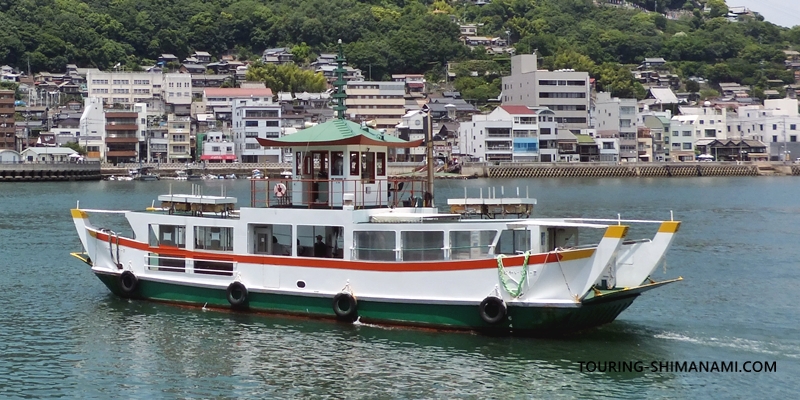
The Ekimae Ferry (literally “Station Front Ferry”) has its boarding point just a 2–3 minute walk from JR Onomichi Station on the San’yo Main Line, making it the most convenient option for tourists and cyclists visiting Shimanami Kaido.
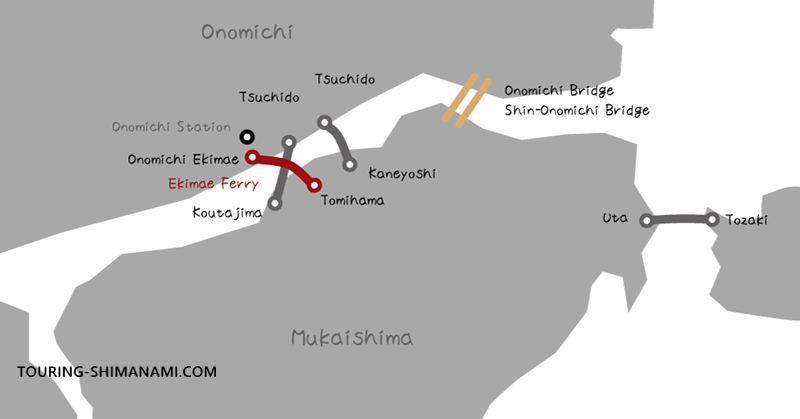
On the Mukaishima side, the ferry travels through a small canal (water channel) into the Tomihama district. Near the Tomihama boarding point are Mukaishima Junior High School and Onomichi Junior and Senior High School, so the ferry is very popular with students during school commuting hours.
| Onomichi – Mukaishima | Ekimae Ferry |
|---|---|
| Operator | Onomichi Watashifune Co., Ltd. |
| Address | 2-10-3 Tsuchido, Onomichi City |
| Phone | 0848-38-7761 |
If you’re using the public rental bicycle service for Shimanami Kaido cycling, the Onomichi Rental Cycle Terminal is also conveniently located close to the Ekimae Ferry boarding point. On Shimanami Kaido, there are both public and private rental bicycle options. For the flexibility of returning your bike at a different terminal (one-way rental), the public rental service — with around 10 terminals along the route — is the most recommended choice for first-time visitors.
Onomichi-Side Boarding Point (Ekimae / Station Front)
If you’re traveling to Shimanami Kaido from Tokyo or Osaka by Shinkansen (bullet train), the most common approach is to ride the Shinkansen to JR Fukuyama Station and then transfer to a local train on the San’yo Main Line to reach Onomichi Station.
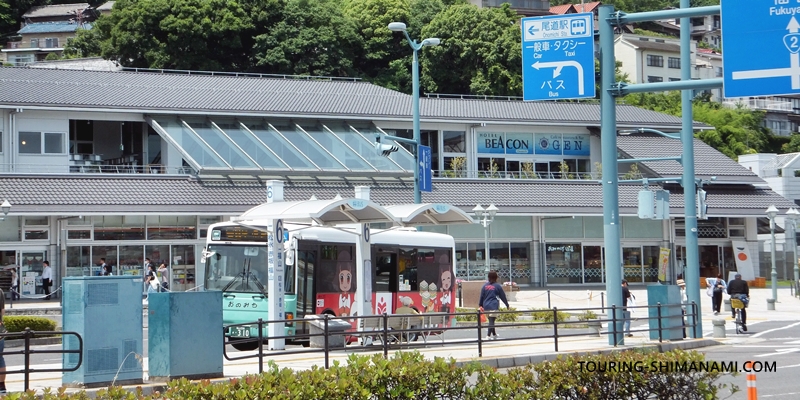
Note that the Shinkansen also stops at Shin-Onomichi Station, but that station is about 4km away from the city center — so for Onomichi sightseeing and Shimanami Kaido cycling, JR Onomichi Station is the main gateway. The station building was renovated in 2019 into a two-story mixed-use complex.
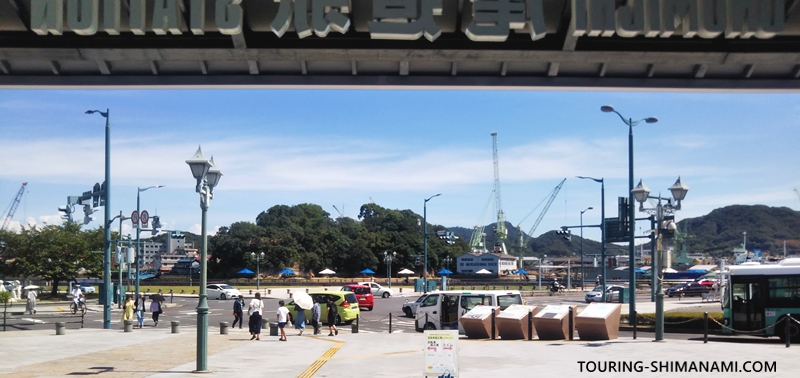
This is the view from the south exit of Onomichi Station. Exit here for the Ekimae Ferry boarding point, the Onomichi Rental Cycle Terminal, the Onomichi shopping arcade (Hondori), and other sightseeing areas. The public rental bicycles commonly used for Shimanami Kaido cycling can be rented and returned at the Onomichi Rental Cycle Terminal, located just steps from the station.
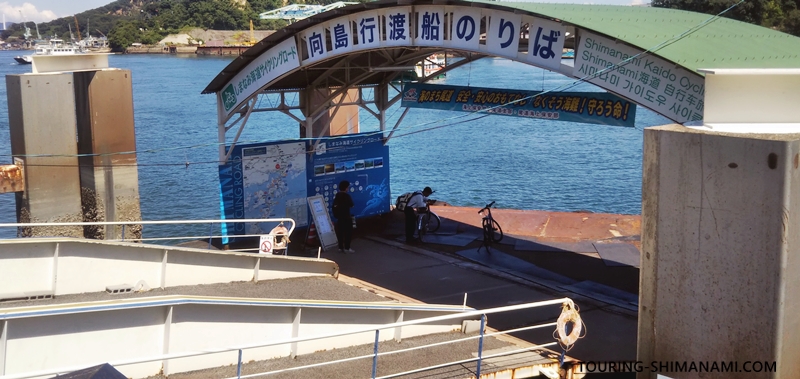
The Ekimae Ferry boarding point is about 200 meters from Onomichi Station. Cross the pedestrian crossing with the traffic lights at the station rotary and you’ll reach the station square. To the right of the square, look for a sign reading “向島行渡船のりば” (Ferry to Mukaishima). A large panel displaying the full Shimanami Kaido cycling map is also installed here, so it’s a good place to review the entire route before setting off.
Mukaishima-Side Boarding Point (Tomihama)
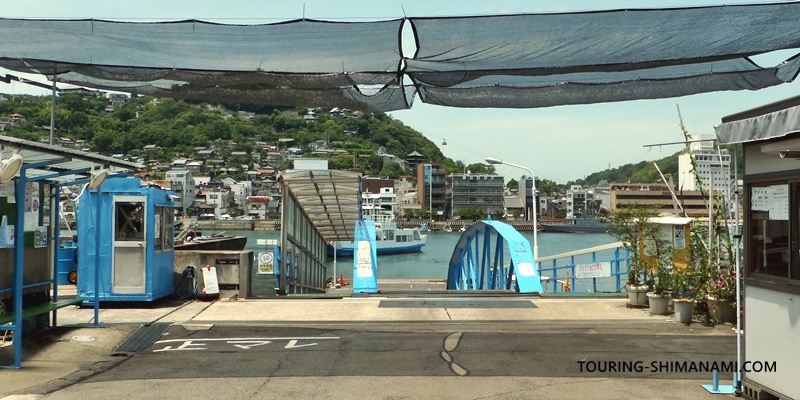
This is the Mukaishima-side boarding point for the Ekimae Ferry.
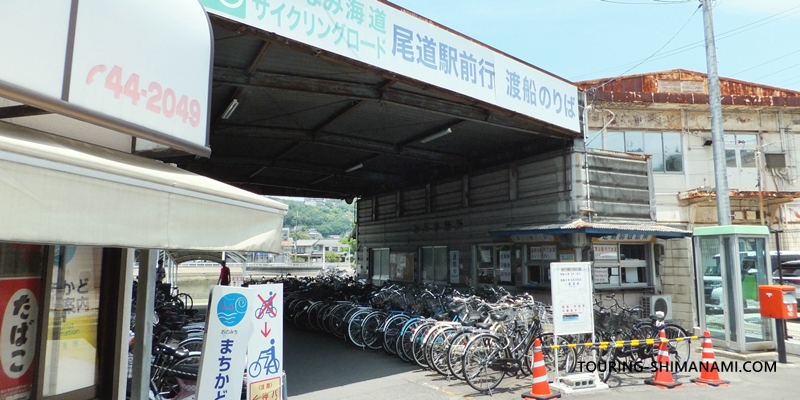
The bicycle parking area is filled with bikes belonging to local residents and students. If you’re starting your Shimanami Kaido cycling from Imabari on the Ehime Prefecture side, this Tomihama boarding point on Mukaishima is where your journey will likely come to an end. Follow the Blue Line and the signage along the main cycling route and you’ll be guided directly to this spot.
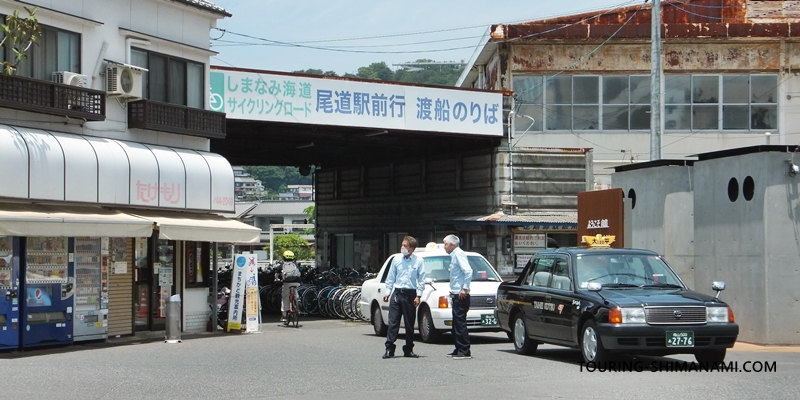
You’ll usually find a few taxis waiting here as well. They can take you for sightseeing in Onomichi, to Takamiyama Observatory or Iwashijima on Mukaishima, or on a broader sightseeing tour of the Shimanami Kaido area.
| Taxi | Bisan Taxi | Taihei Kotsu |
|---|---|---|
| Address | 3101-9 Yamanami-cho, Onomichi City | 232-27 Mukaishima-cho, Onomichi City |
| Phone | 0848-37-2800 | 0848-44-1600 |
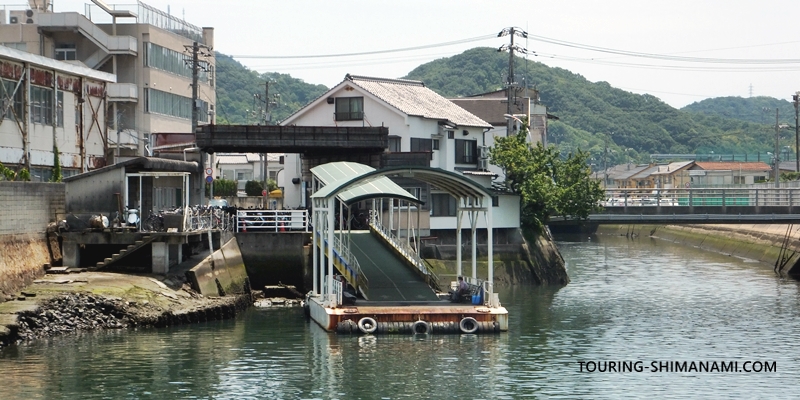
Viewed from the other direction, the Tomihama boarding point looks like this — a pier jutting out into the canal, with the ferry docking head-on from the front.
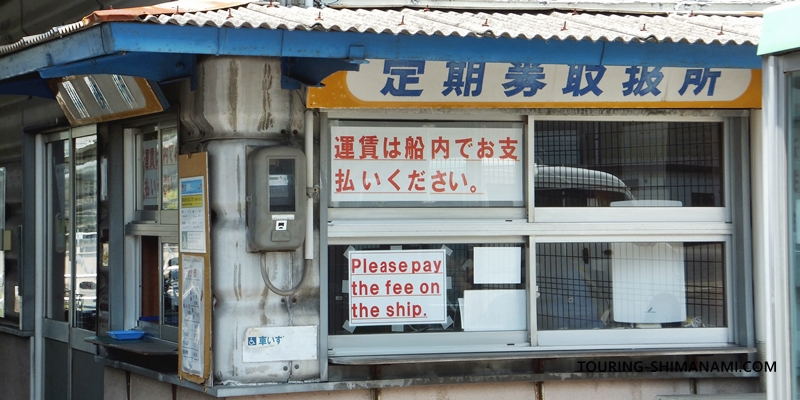
At the Tomihama boarding point, there is a small booth that looks like a ticket window, but this is only for the sale of commuter passes for regular users. If you’re visiting as a tourist, you don’t need to buy anything here. As the sign says, “Fare is collected on board” — a crew member will come around to collect payment during the crossing.
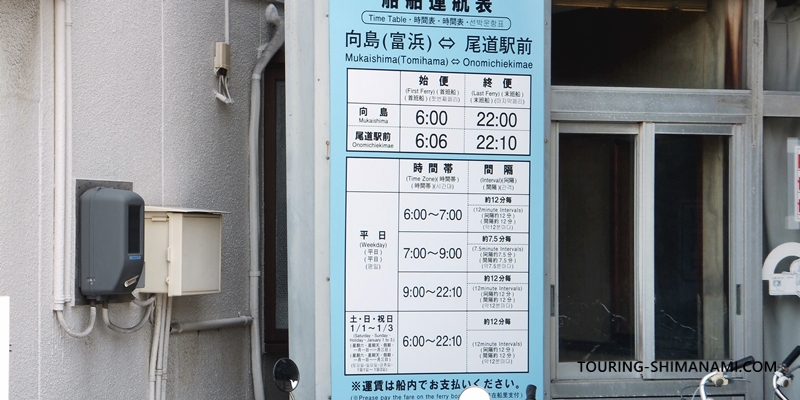
An operating schedule is also posted at the Ekimae Ferry boarding point, but it is very simple. As mentioned before, there is no fixed timetable — the ferry simply runs continuously between the station front and Tomihama from the first to the last departure. You can see that during school commuting hours on weekdays, the ferry runs at an even higher frequency.
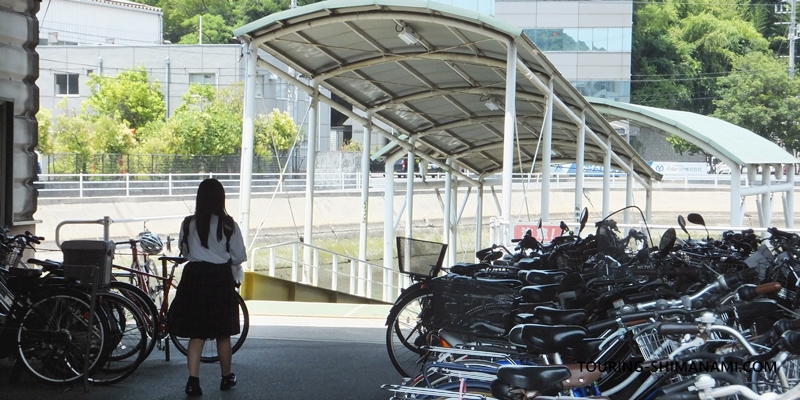
If you’re starting your Shimanami Kaido cycling journey here, this short ferry ride makes for an exciting opening to your cycling adventure. If Onomichi is your finish line, it’s a gentle and reflective way to close the journey — waiting for the ferry, watching the Onomichi cityscape come into view from the water, and quietly revisiting the roads you’ve cycled along the way.
AD (Google AdSense)
② Kaneyoshi Ferry (Onomichi Ferry)
Next, I’ll take a closer look at the Kaneyoshi Ferry, located at the easternmost point of the Onomichi Channel.
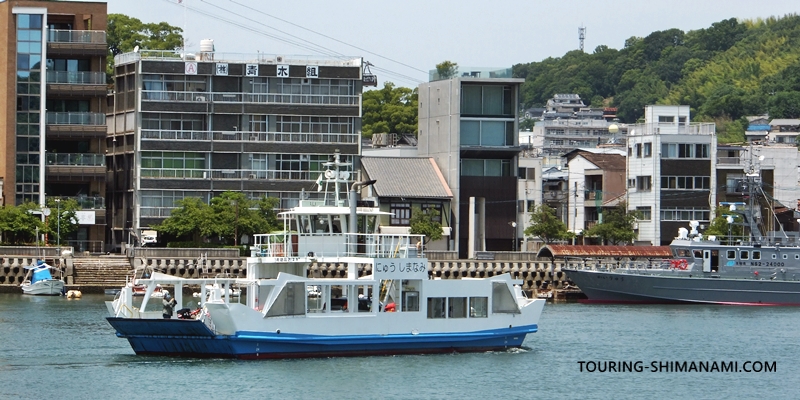
It is currently operated by a third-sector company (a public-private partnership), Onomichi Watashifune Co., Ltd., and is sometimes simply referred to as the “Onomichi Ferry” or the “public ferry” (公営渡船, koei tosen), a name that reflects its origins as a publicly run service.
This route was used as a filming location for the NHK morning serial drama Teppan (2010–2011), which was set in Onomichi, and for the 1995 film Ashita (Tomorrow) directed by the late Nobuhiko Obayashi — a director renowned for his many Onomichi-set films.
| Onomichi – Mukaishima | Kaneyoshi Ferry (Onomichi Ferry) |
|---|---|
| Operator | Onomichi Watashifune Co., Ltd. |
| Address | 2-10-3 Tsuchido, Onomichi City |
| Phone | 0848-38-7761 |
Onomichi-Side Boarding Point (Tsuchido)
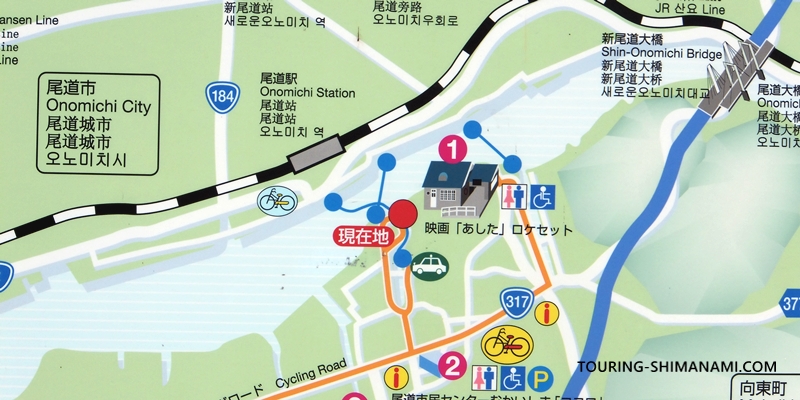
The Onomichi-side boarding point for the Kaneyoshi Ferry is a simple, modest pier like this. It is about 900 meters from Onomichi Station — the farthest from the station of the three routes.
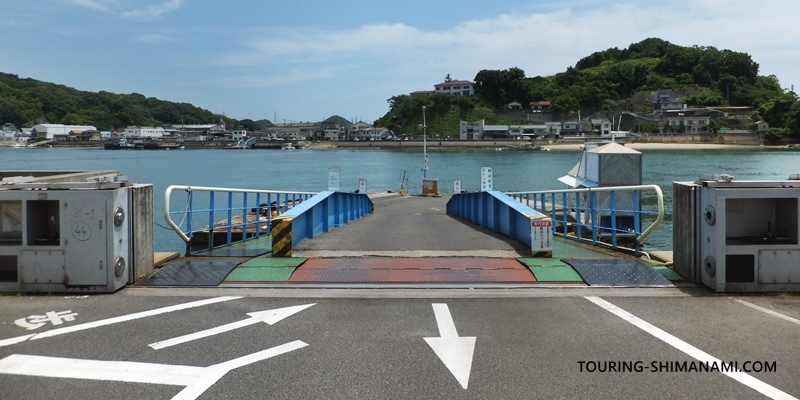
The Kaneyoshi Ferry is particularly convenient if you plan to stroll through the Onomichi shopping arcade before heading to Mukaishima, if you want to cycle the outer perimeter of Mukaishima, or if you need to reach the Mukohigashi Bus Stop (向東BS) — a stop on the highway bus route between Onomichi and Imabari.
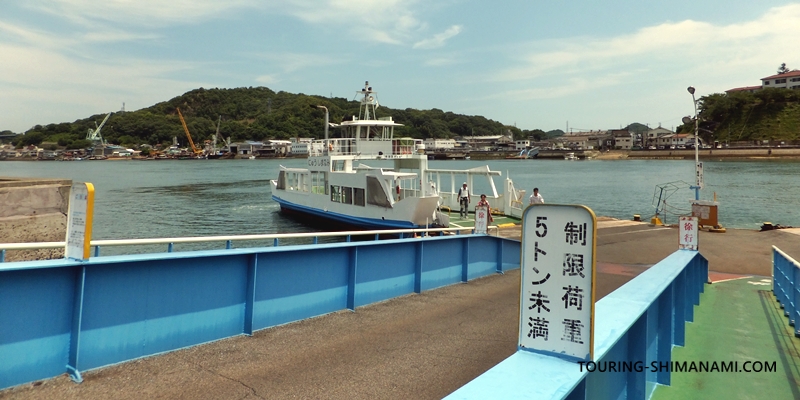
The Kaneyoshi Ferry docks with its bow facing the left side of the pier. When it arrives, cars and other vehicles disembark first — please wait to the side of the pier until a crew member signals that boarding can begin.
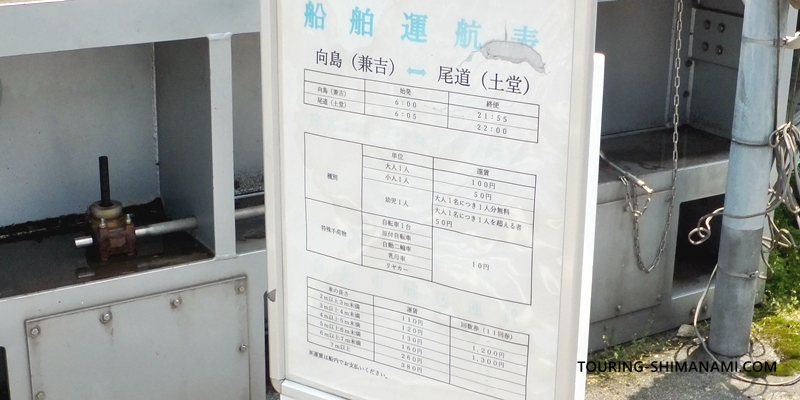
The Kaneyoshi Ferry’s timetable is also very simple. Interestingly, strollers (baby carriages) and hand carts are listed as “special luggage” with a ¥10 surcharge — a small detail that hints at the variety of ways local residents rely on this ferry for everyday life.
Mukaishima-Side Boarding Point (Kaneyoshi)
This is the Mukaishima-side boarding point for the Kaneyoshi Ferry.
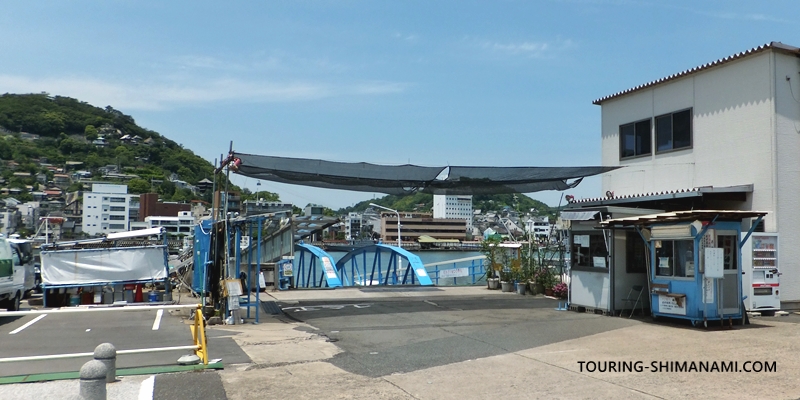
Next to the pier stands a prefabricated building that serves as the office of Onomichi Watashifune Co., Ltd., which manages the route. In 2024, Onomichi City made local news when it had a new ferry vessel specially built and loaned to the operator at no charge in order to support the continuation of this public transportation link.
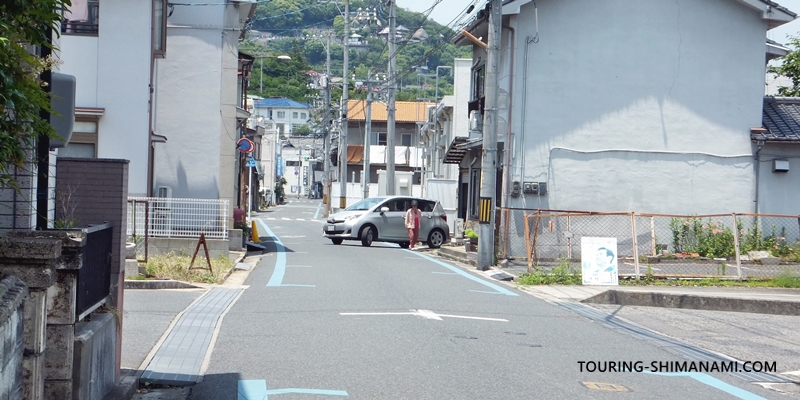
Just beside the Kaneyoshi boarding point is a small canal, and the Blue Line cycling route is painted along the narrow road one block to the west. Follow this road from the Tozaibashi intersection on National Route 317 (also designated Prefectural Route 377) to reach the boarding point. Along this road you’ll also find some popular local spots, including Sumida Bakery (famous for its twisted nejipan bread) and Goto Kosenjo (famous for its local craft ramune soda).
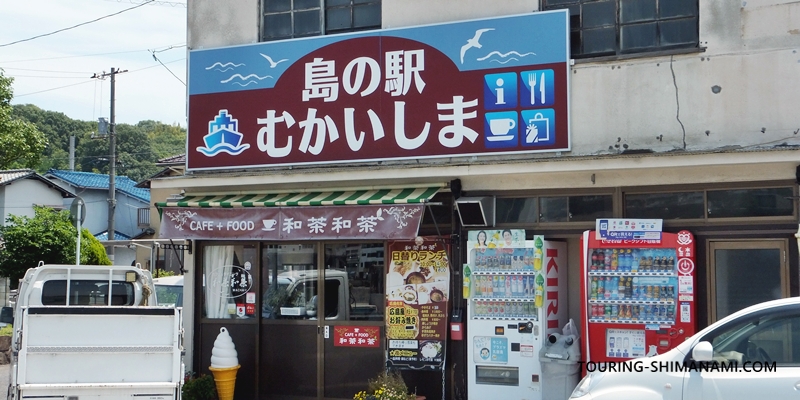
A small plaza in front of the Kaneyoshi boarding point is home to a facility called “Shima no Eki Mukaishima” (Mukaishima Island Station). It has a café space called Wasawasa attached, making it a nice spot to take a short break.
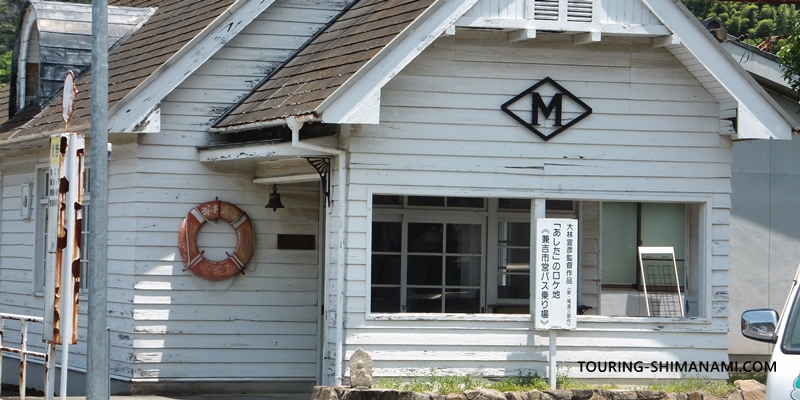
Just in front of the boarding point, you’ll also find a preserved film set used as a harborside waiting room in director Nobuhiko Obayashi’s 1995 film Ashita (Tomorrow). It now serves as a bus shelter, with several exhibition panels inside — a must-see spot for fans of Obayashi’s work.
AD (Google AdSense)
③ Fukumoto Ferry
The Fukumoto Ferry — one of the three ferry routes between Onomichi and Mukaishima — was discontinued at the end of March 2025.
The Fukumoto Ferry was the least known of the three routes among cycling visitors — partly because the Kouta boarding point on the Mukaishima side was a little tricky to find.
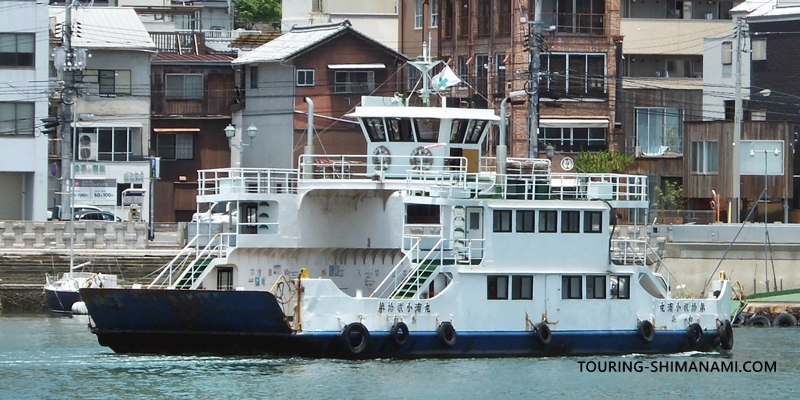
With the lowest fares of the three routes, it was particularly popular among local commuters and students, and had a distinctly local, everyday character. I personally loved this route for the tent-style fare booth and the distinctive gate sign on the Onomichi side — details that carried a real sense of old-fashioned Onomichi atmosphere.
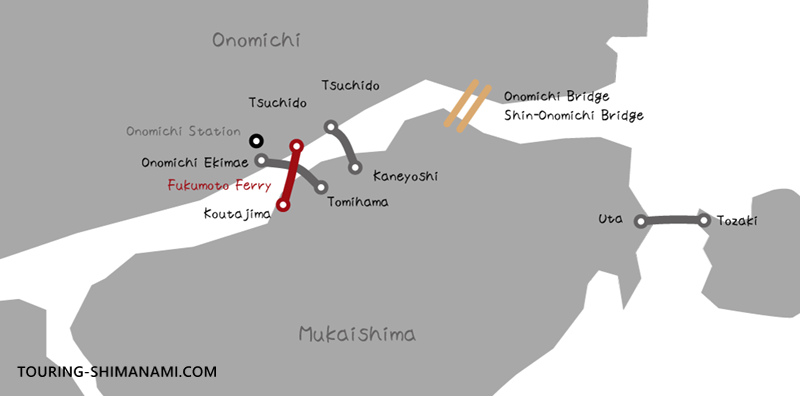
It was also the most historically significant route, having been used as a filming location for director Nobuhiko Obayashi’s Onomichi-set films Futari (1991) and Sabishi Nbo (1985).
Onomichi-Side Boarding Point
The Onomichi-side boarding point for the Fukumoto Ferry was easy to find.
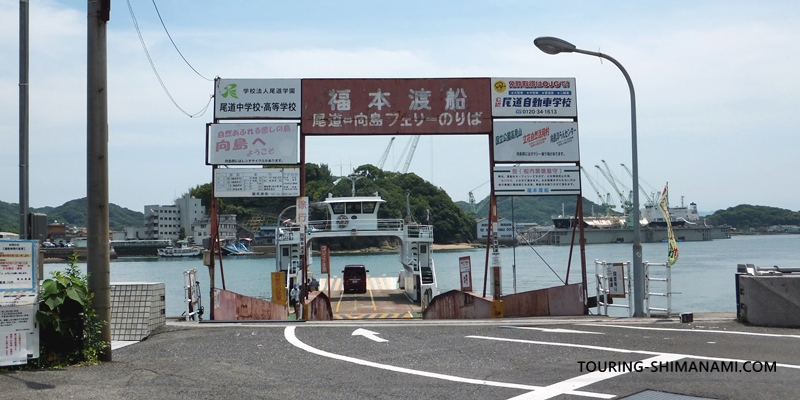
About 350 meters east of Onomichi Station along the waterfront road, on the seaward side of the Onomichi Hondori shopping arcade in the Tsuchido 1-chome neighborhood, stood a large vermilion gate sign reading “Fukumoto Ferry — Onomichi ⇔ Mukaishima Ferry.” It was hard to miss.
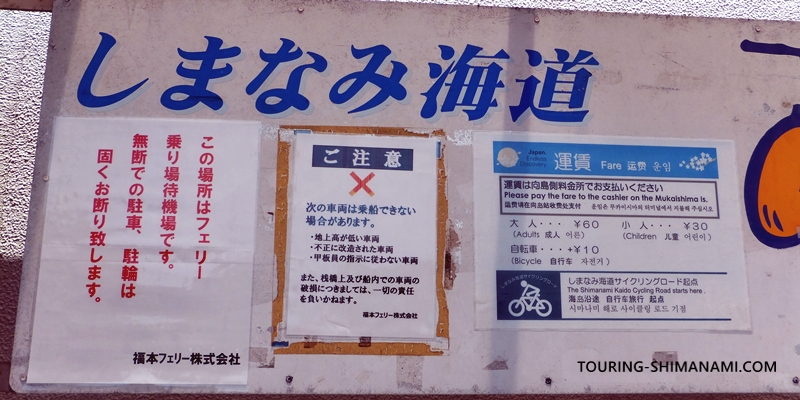
The Fukumoto Ferry’s Onomichi-side boarding point also had a sign marking it as one of the starting points for Shimanami Kaido cycling. In front of the sign were about four car waiting spaces. If you were on a bicycle, it was better to wait to the side so as not to block the cars. Once the ferry docked, the cars disembarked first, and boarding began once they had all cleared.
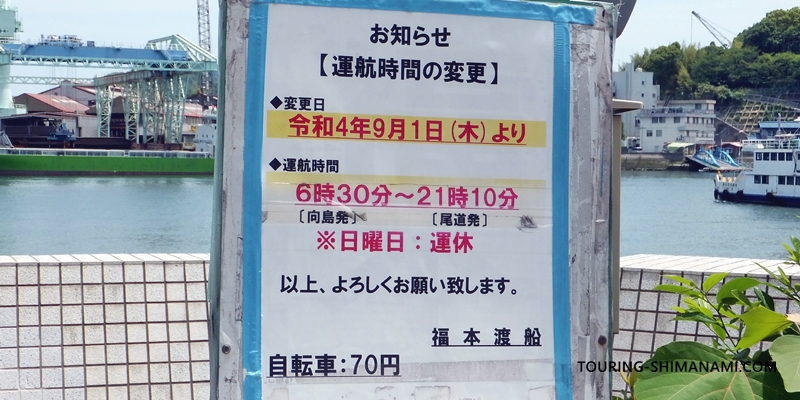
From September 1, 2022, the Fukumoto Ferry had changed its operating hours — reducing them slightly — and had stopped running on Sundays. This reflected the fact that the route was primarily used by local commuters and students rather than tourists.
Mukaishima-Side Boarding Point (Kouta)
The Kouta boarding point for the Fukumoto Ferry on the Mukaishima side was, as mentioned, a little tricky to find.
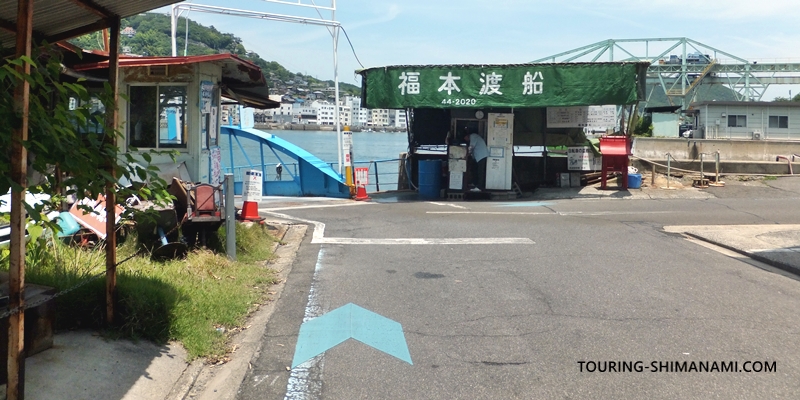
It was located further down the canal from the Ekimae Ferry’s Tomihama boarding point, closer to the river mouth where the canal meets the Onomichi Channel. A green tent with “Fukumoto Ferry” written on it marked the fare gate. Unlike the other two routes, at the Fukumoto Ferry you paid the fare in cash at this booth on the Mukaishima side before boarding.
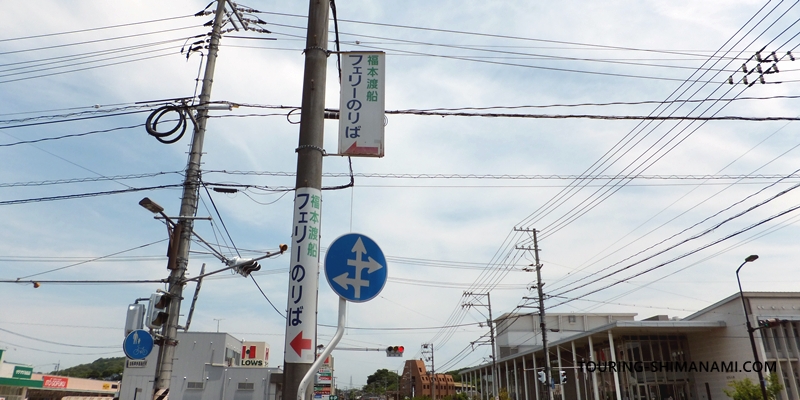
If approaching from the Shikoku (Imabari) side along the Shimanami Kaido main route, you’ll reach the Tomihama-bashi intersection on National Route 317 (Prefectural Route 377), where an electric pole displays a sign: “Fukumoto Ferry boarding point ←.” This intersection is also where the Onomichi Community Center Mukaishima (which doubles as a rental cycle terminal) is located. Turning left and following the Blue Line leads to the Ekimae Ferry’s Tomihama boarding point — so instead, continue north along the canal to reach the Fukumoto Ferry.
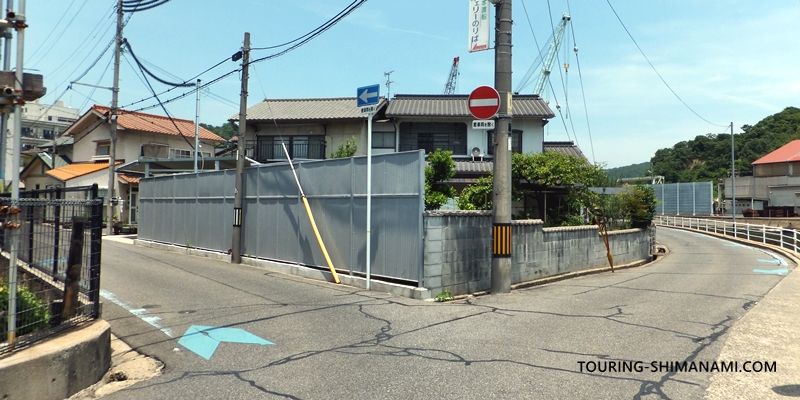
Continuing about 300 meters along the canal beside Mukaishima Junior High School, you’ll reach the intersection shown in the photo above. From here to the Fukumoto Ferry boarding point, the road is one-way for motor vehicles (but not for light vehicles such as bicycles). The one-way section loops around in a circle. Drivers should turn left here and follow the one-way road to the boarding point.
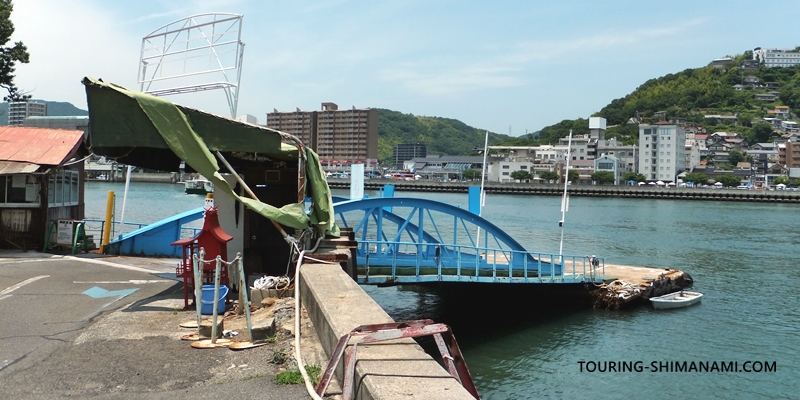
After paying the fare, cyclists would walk their bike along the blue pier and wait to the side. Cars and motorcycles waited in painted waiting spaces on the left side of the road. Once the ferry arrived and all vehicles had disembarked, boarding would begin. And once everyone was on board, the ferry would set off — almost without warning — and before you knew it, you’d arrive in Onomichi, watching the townscape drift by.
On Shimanami Kaido, where you cross one grand bridge after another, the small ferry crossing at the very start or end of the journey has its own special charm — a sense of activity and the distinctive atmosphere of old Onomichi. Starting the day with a fresh sea breeze, or perhaps finishing it with a sunset over the Onomichi skyline viewed from the water.
AD (Google AdSense)
Other Ferry Routes in the Area
Uta–Tozaki Ferry Route
The Uta–Tozaki Ferry, connecting Uta Port on Mukaishima with Tozaki Port, is a hidden gem that sees little use from Shimanami Kaido cyclists but is a fascinating route in its own right.
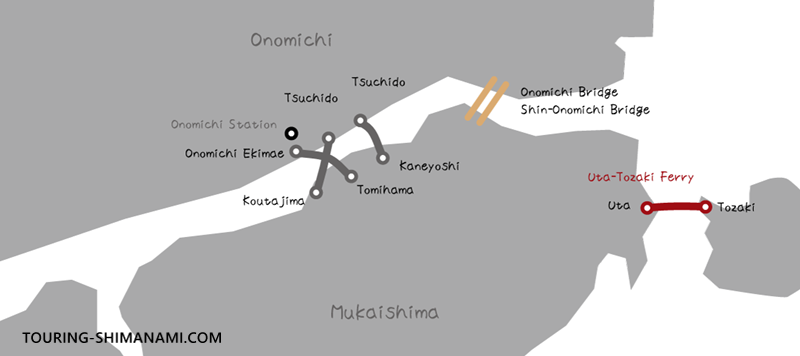
From Onomichi city center, reaching the Numakuma Peninsula to the south (in Fukuyama City) requires a long detour around Matsuura Bay. This ferry cuts that journey significantly. The Numakuma Peninsula is also home to the historic port town of Tomonoura, making this route a convenient option for those who want to explore that area.
| Onomichi Area | Uta–Tozaki Ferry Route |
|---|---|
| Operator | Onomichi Watashifune Co., Ltd. |
| Address | 2-10-3 Tsuchido, Onomichi City |
| Phone | 0848-38-7761 |
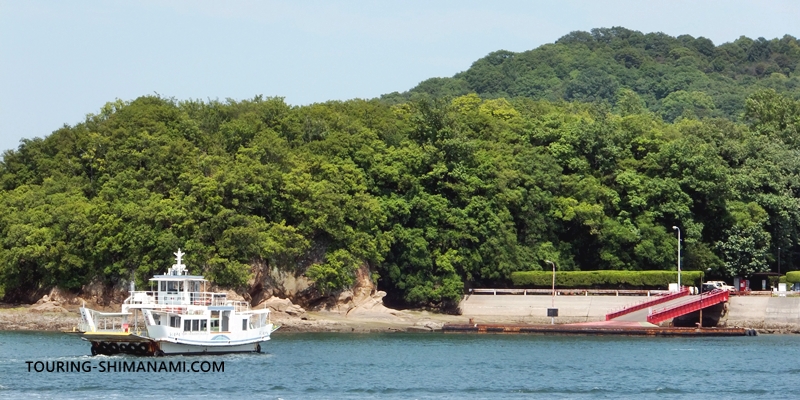
Like the other Onomichi–Mukaishima ferries, the Uta–Tozaki route only has a set first and last departure time — no fixed timetable in between. On Sundays and public holidays, the first and last departure times differ from weekdays.
| Timetable | Uta–Tozaki Ferry Route |
|---|---|
| First Departure | 6:30 |
| Last Departure | 19:30 |
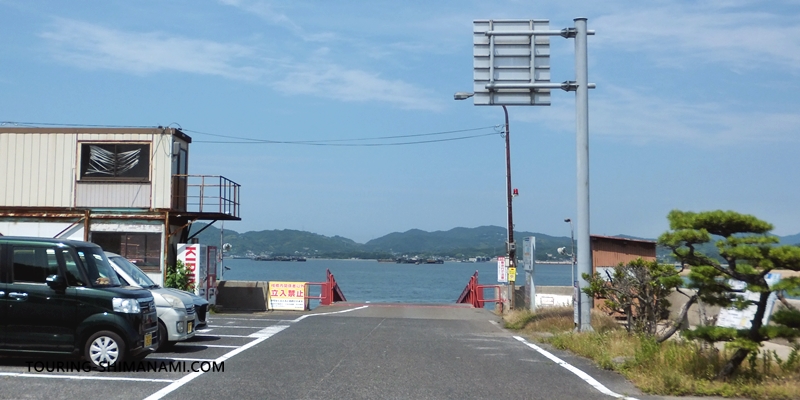
This is the Uta Port boarding point on the Mukaishima side. Located deep in one of the eastern communities of Mukaishima, the boarding point is essentially unstaffed. The ferry runs approximately every 15 minutes between Uta and Tozaki, but when no one is waiting, the ferry may stop. For this reason, a call button is installed at the boarding point so that passengers can summon the ferry when needed.
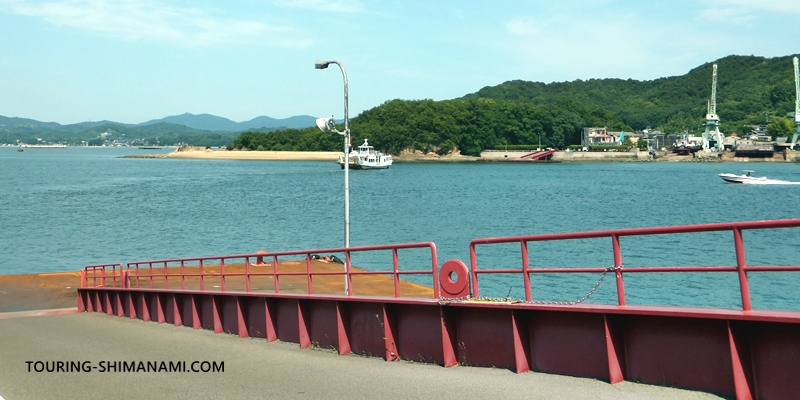
I find the “no timetable, just press the button to call the ferry” system wonderfully unique. Apparently, in earlier times you’d wave your arms or flip a black-and-white signboard to call the boat over. It’s the kind of one-of-a-kind travel experience you just don’t find anywhere else — I’d love for you to try the Uta–Tozaki Ferry if you ever get the chance.
Ferry Routes on the Shimanami Kaido
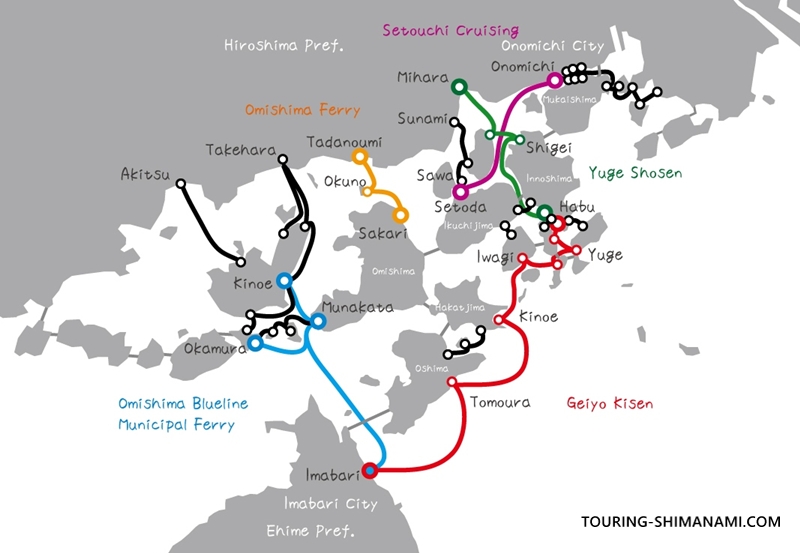
Since the expressway bridges opened, many of the old ferry and passenger boat routes in the Shimanami Kaido area have disappeared — but a handful of routes remain active. Ferries that carry bicycles can be useful for shortcutting or varying your cycling route. I’ve put together a full summary of the remaining ferry routes on Shimanami Kaido, which you’re welcome to use as a reference when planning your cycling trip.
AD (Google AdSense)
Frequently Asked Questions
- QCan I cycle across the Onomichi Bridge instead of taking the ferry?
- A
The Onomichi Bridge is open to cars and motorcycles, but it is not recommended for cyclists. The road shoulder is very narrow, and the sidewalk has obstacles that make it both stressful and potentially dangerous to ride through. The official cycling route of the Shimanami Kaido — marked by the blue guideline painted on the road — directs cyclists to the ferry terminal rather than the bridge. For anyone travelling by bicycle or on foot, the ferry is by far the better option.
- QWhat are the operating hours of the ferries?
- A
There are currently two ferry routes crossing the Onomichi Strait between Onomichi and Mukaishima Island: the Ekimae Ferry and the Kaneyoshi Ferry. Neither operates on a fixed timetable — instead, each ferry makes frequent return trips between the two sides throughout the day.
The Ekimae Ferry runs from 6:00 AM (first departure from Mukaishima) until the last departures at 22:00 from Mukaishima and 22:10 from Onomichi. The Kaneyoshi Ferry runs from 6:00 AM until 22:25 from Mukaishima and 22:30 from Onomichi. For a typical Shimanami Kaido cycling itinerary, you won’t need to worry much about the schedule — just head to the terminal and the next boat will arrive within a few minutes.
- QHow much does the ferry cost? I’ll be bringing a bicycle.
- A
The fare is very affordable. Both the Ekimae Ferry and the Kaneyoshi Ferry charge ¥100 for an adult passenger, plus ¥10 for a bicycle as hand luggage — a total of ¥110 per person with a bike. Children (elementary school age and under) pay half the adult fare. You can ride your bicycle straight onto the boat without folding or disassembling it, which makes it very convenient for cyclists.
- QCan I pay by credit card or IC card (like Suica or Icoca)?
- A
Unfortunately, both ferries are cash only. Credit cards, debit cards, IC cards (such as Suica, Icoca, or Pasmo), and other electronic payment methods are not accepted. There are no tickets to buy in advance either — the crew members will come around to collect the fare while you are on board.
We recommend having small change ready before boarding. There is a convenience store near Onomichi Station where you can get cash or make change ahead of time. Having ¥110 per person ready to go will make the boarding process smooth and easy.
- QWhich ferry should I use for the Shimanami Kaido cycling route?
- A
For most visitors cycling the Shimanami Kaido, the Ekimae Ferry (駅前渡船, Ekimae Tosen) is the most convenient choice. Its Onomichi-side terminal is just about 200 metres from JR Onomichi Station, and the blue guideline on the road leads you directly to the boarding point. Whether you are starting your ride from Onomichi or finishing here after cycling from Imabari, this is the ferry most Shimanami Kaido cyclists use.
The Kaneyoshi Ferry (兼吉渡し, Kaneyoshi Watashi) docks on the eastern side of Mukaishima Island, which makes it a great option if you want to explore the island’s outer coastal cycling route, or visit popular local spots like Sumida Bread Factory or Goto Kosenjo. It is also convenient if you have been sightseeing along Onomichi’s shopping arcade before heading to the island.
- QDo I need to make a reservation to board the ferry?
- A
No reservation is needed at all. Simply make your way to the ferry terminal and wait for the next departure. The ferries run frequently — roughly every 10 minutes or so — so you will rarely wait long. During morning and evening commuting hours, the frequency increases to around every 5 minutes. It is one of those wonderfully simple, no-fuss experiences that makes travelling in this part of Japan so enjoyable.
- QCan I bring a rental bicycle on the ferry?
- A
Yes, absolutely. All rental bicycles — including the cross bikes available from the public rental cycle service (Shimanami Kaido Rental Cycle) — can be taken on both ferries without any issue. If you are renting from the Onomichi Rental Cycle Terminal near the station, it is just a short ride to the Ekimae Ferry terminal. Simply wheel your bike on board when it’s time to embark.
- QAre there English signs at the ferry terminals? Will the staff understand English?
- A
The ferry terminals are small and quite simple in layout, so even without reading Japanese you should be able to find your way. The Onomichi-side terminal for the Ekimae Ferry has a large arch-shaped sign reading “向島行渡船のりば” (Ferry to Mukaishima), and the blue cycling route guideline on the road will point you in the right direction. English signage at the terminals themselves is limited, but the boarding process is straightforward — just wait at the dock, follow the other passengers on board when the boat arrives, and have your ¥110 ready.
The ferry crew members are local and may not speak much English, but communication is minimal — you simply hand over your fare and enjoy the short crossing. A smile and ¥110 is really all you need!
- QIs the Fukumoto Ferry still operating? I saw it mentioned online.
- A
The Fukumoto Ferry (福本渡船) ceased operations at the end of March 2025. As of now, the two active ferry routes between Onomichi and Mukaishima Island are the Ekimae Ferry and the Kaneyoshi Ferry only. Some older travel blogs or websites may still list the Fukumoto Ferry, so please be aware that this information is out of date.
- QWhat should I do at the terminal? Is there a specific way to board with a bicycle?
- A
The boarding process is simple and relaxed. When you arrive at the terminal, wait near the dock for the ferry to pull in. When it arrives, passengers and vehicles will disembark first — please wait until they have all come off before boarding. Once the crew signals that it is time to get on, wheel your bicycle on board and lean it against the wall or railing inside the boat. The crew will come around to collect your fare (¥110 per adult with a bicycle) while the boat is crossing. Watch your step when boarding and disembarking, as the gap between the boat and the dock can shift slightly with the water.
The crossing itself takes just 3 to 5 minutes, so before you know it you will be on Mukaishima Island — or back on the Onomichi side — ready for the next part of your journey.
On this page, I’ve introduced the local ferries that run between Onomichi and Mukaishima on Shimanami Kaido. One of the greatest things about cycling Shimanami Kaido is that even first-time visitors can enjoy the journey with confidence. For more detailed information on Shimanami Kaido cycling, please see the page below — I hope it’s helpful for your planning!