

It has been reported that Geiyo Kisen Co., Ltd. will withdraw from its scheduled route between Imabari Port and Habu Port on Innoshima at the end of March 2028. Based on the news coverage, I’ve sorted out the background to the decision, what it means for access to the Yumeshima Kaido, and how it affects shortcuts during a ride.
Geiyo Kisen’s Withdrawal from Its Scheduled Route
On October 26, 2026, Geiyo Kisen Co., Ltd. announced that it will withdraw from its scheduled route between Imabari Port and Habu Port on Innoshima around the end of March 2028.
The route calls at Oshima, Hakatajima, and the islands of Kamijima Town (the Yumeshima Kaido, a group of small islands connected by bridges). It has supported the daily lives of the people who live on these islands, and for cyclists touring the Shimanami Kaido, it has also been one of the reassuring options, because you can take your bike right onto the boat.

Some of you may have used it to cross from Imabari to the Yumeshima Kaido, or as a shortcut partway through a ride. In this article, I’ll sort through what has been reported and share my own thoughts on the background to the withdrawal, its impact on cycling trips, and what might come next.
- Details of the Geiyo Kisen withdrawal news
- Why the route has become hard to sustain
- How the discontinuation affects cycling
I think this is news that will have a big impact on Shimanami Kaido cycling in the years ahead.
The High-Speed Boat Between Imabari Port and Habu Port
First, let me go over the basics of the route in question and how things got to this point.
The route affected by the announcement is a high-speed boat service from Imabari Port to Habu Port on Innoshima. Along the way, it stops at Tomoura on Oshima, Kinoura on Hakatajima, and Iwagishima Island, Sashima Island, Yugejima Island, and Ikinashima Island in Kamijima Town.
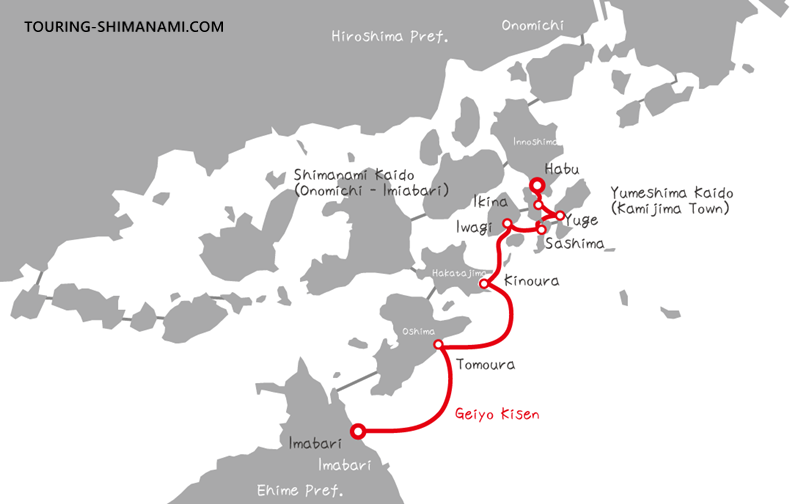
The boats in service are the high-speed boats Tsubame and Daiichi Chidori. A one-way trip takes about 1 hour 20 minutes, and there are currently 4 round trips a day (it used to be 7 or 8). The boats carry bicycles and luggage as well as passengers. Please note, though, that some sailings can’t take bicycles or luggage, and there may be a limit on the number of bicycles, so it’s worth checking before you plan to use it.
Separate from the bridge route of the main Shimanami Kaido, this is a sea route that links the islands, and it’s a rare way to travel directly from Imabari to the islands of the Yumeshima Kaido. It’s also a route that offers a different kind of island trip from cycling over bridges, one that only a boat can give you.
Withdrawal Announced for Around the End of March 2028
On October 26, 2026, Geiyo Kisen announced that it plans to withdraw from this route around the end of March 2028, which is the end of fiscal year 2027 (Japan’s fiscal year runs from April to March). Geiyo Kisen was established in 1987 with investment from Onomichi City, Imabari City, Kamijima Town, and others, and has operated the Imabari to Innoshima route since 1988. Until March 2024 it ran 7 round trips a day, so services have been cut back repeatedly over the past few years.
Geiyo Kisen has no business other than this route, so it has been reported that the company will move toward closing down after the withdrawal. It would bring a history of nearly 40 years to an end. I’ve also put together information on the Geiyo Kisen route and how cyclists can make use of it in the article below.
AD (Google AdSense)
Why Is Geiyo Kisen Withdrawing?
According to the reports, the withdrawal is the result of several factors piling up rather than a single cause.
Fewer Passengers and a Shrinking Local Population
According to the reports, annual ridership has fallen from about 500,000 passengers when the service began to about 61,000 in recent years.
Behind this are the openings of a series of bridges, including the Shimanami Kaido in 1999 and the bridges of the Yumeshima Kaido: the Yuge Bridge (1996), the Ikina Bridge (2011), and the Iwagi Bridge (2022). Getting around the islands by car or bus became easier, and fewer and fewer people rode the boat. Population decline and aging in the area are also cited as reasons for the drop in passengers.

Bridges made life on the islands more convenient, but at the same time, it seems the number of people supporting sea transport shrank. When a bridge opens, fewer people need a boat for everyday trips, and perhaps that’s only natural. Also, while the number of cyclists visiting the Shimanami Kaido is growing, I imagine only some of them use this boat.
Rising Fuel and Labor Costs and a Shortage of Crew
While ridership has been falling, operating costs such as fuel, vessel expenses, and labor have been going up. It’s also reportedly getting harder to secure crew for the boats. TSS TV Shin-Hiroshima also mentions aging vessels among the reasons Geiyo Kisen gave. Each news outlet emphasizes slightly different points, but they seem to agree on this: falling ridership, rising costs, and a labor shortage together have made it difficult to keep operating safely and reliably.
By the way, the Karouto Ferry, which links Innoshima and Yugejima Island, was once expected to end at the end of March 2026. It has since continued, though with fewer sailings and no service on Sundays or maintenance days, so it’s worth checking the timetable before you go.
For all sorts of reasons, it’s becoming harder to keep public transportation running on remote islands and in depopulated areas.
Impact on Local Communities and Travelers
Here I’d like to look at the impact from two sides: transportation for the people who live on the islands, and the view from travelers.
A Vital Lifeline for Residents
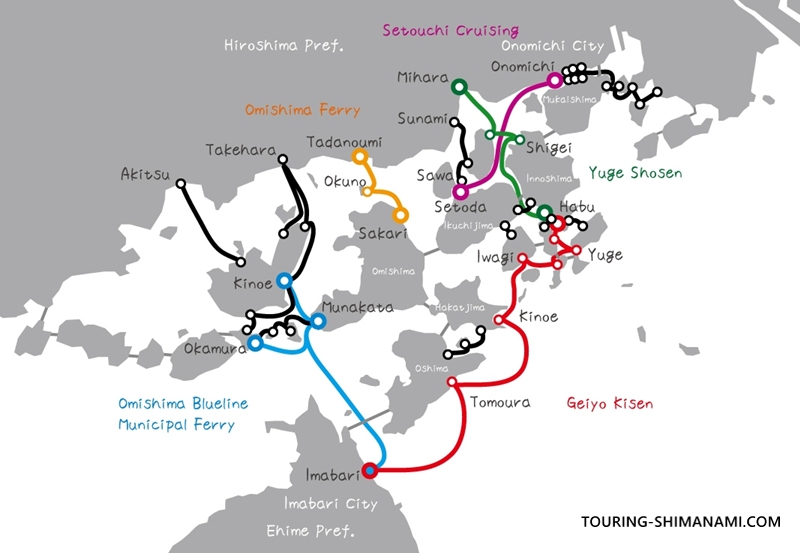
This is the only scheduled route linking Imabari City and Kamijima Town. The islands of Kamijima Town are right next to Innoshima (Onomichi City, Hiroshima Prefecture), and residents often go there for shopping and the like. Even so, quite a few people still need to get to downtown Imabari, or to Oshima and Hakatajima, which are part of Imabari City. For commuting to work or school, hospital visits, and more, it’s an important means of getting around in daily life.

Kamijima Town has said it wants to keep discussing the continuation of the route with Imabari City and Onomichi City so that residents can live with peace of mind. Onomichi City has also reportedly expressed gratitude for Geiyo Kisen’s service so far and said it will discuss what comes next.
It’s reported that Geiyo Kisen chose the end of March 2028 as the withdrawal date out of consideration for the impact on passengers and employees. Kamijima Town’s remarks suggest how seriously it takes the effect on residents’ lives. I think this isn’t only a tourism issue, but one that touches the very foundations of life for the people who live on the islands.
What Happens to Access to Kamijima Town After the Route Ends?
According to a report by Television Ehime, the access method currently envisioned after the route ends is to take a bus along the Shimanami Kaido and transfer at Habu Port on Innoshima to a boat run by a different company.

If you can no longer cross directly from the Imabari side, transfers will become quite cumbersome and travel time will increase, and I’m concerned about the burden of carrying luggage and bicycles. Cycling the Yumeshima Kaido may drop off the list of options for many travelers.
That said, no replacement operator or specific means of transport has been decided at this point. I’d like to keep an eye on the discussions ahead.
Impact on Shimanami Kaido Cycling
From here, I’d like to think about the withdrawal from the perspective of a cycling trip, which the news reports haven’t covered in much detail.
Access from Imabari to the Yumeshima Kaido Will Be Affected
This route has been a valuable way to take your bike from downtown Imabari to the islands of the Yumeshima Kaido. Riding around Yugejima Island, Ikinashima Island, Sashima Island, and Iwagijima Island and then continuing on to Innoshima has a different kind of island-hopping appeal from the main Shimanami Kaido route. After the withdrawal, options like this will become fewer. The impact looks especially large for travelers heading to the Yumeshima Kaido from the Imabari side.
Shortcuts During a Ride Will Become Harder
People have also used this route as a way to shorten a ride partway through cycling the Shimanami Kaido, by taking the boat with their bike. If you have a public rental bike, you can also return it at a terminal along the way and take a bus.
On the other hand, if you’re riding your own bike or a privately operated rental bike, you have to carry the bike yourself even when you take public transportation as a shortcut. If you wish to transport a bicycle on an express bus in this area, you must disassemble it and place it inside a specialized carrying bag, known as a “rinko” bag. For cyclists, a boat that carries the bike as it is is a much easier option to use than a bus.
For example, imagine you rent a bike from a private shop in Onomichi and ride to Imabari and back over two days. If you’re more tired than expected on the second day, right now you could take the boat from Imabari to Innoshima and ride the rest of the way to Onomichi from there. Being able to shorten the distance and change your plans flexibly to match your energy is one of the great things about the boat. After the withdrawal, that kind of flexibility will be reduced.


Beginner Cycling Plans Will Be Affected, Too
With the boat, you can shorten the distance and plan a route to match your fitness. One-day beginner cycling plans that assume the use of Geiyo Kisen will no longer work as they are after the withdrawal.
I think one of the charms of the Shimanami Kaido is that you don’t have to ride the whole way by bike. You can mix in boats and buses and build an itinerary freely. I feel that having fewer transport options will also affect beginners and anyone who is anxious about riding long distances.
Maps You Should Get in Advance
“CycloTourisme Shimanami,” which has been active in cycle tourism and regional promotion for nearly 20 years along the Shimanami Kaido, publishes guidebooks and maps. The map is also available in English and is extremely popular because it is the most detailed cycling-specific map in this region.
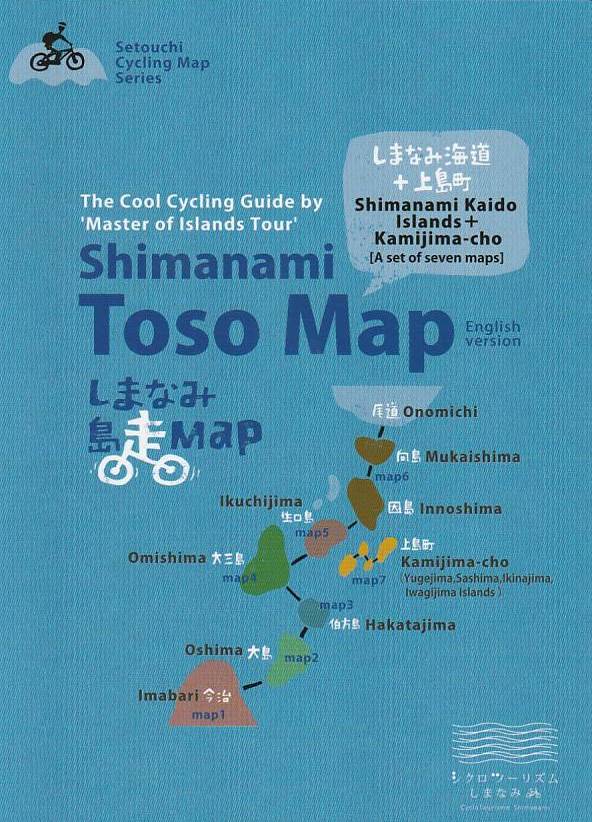
This product comes with a set of seven maps, each with a fairly detailed map for each island. I believe that getting your hands on this map will change your experience here. It can be purchased on Amazon.co.jp, and you can also buy it locally at Guesthouse CYCLONOIE in front of Imabari Station.
What Happens to the Route Next? Possible Alternatives
Here I’ll introduce the moves that have followed the withdrawal announcement, as well as a cycle ship initiative by a different company.
Talks Among Imabari City, Onomichi City, and Kamijima Town on Keeping the Route
Kamijima Town says it wants to continue discussions on keeping the route in order to protect residents’ lives, and Onomichi City has also indicated that it intends to talk with Imabari City and Kamijima Town.
However, current reports haven’t made clear things such as a replacement operator, subsidies, the timetable, or whether bicycles could be carried. Geiyo Kisen withdrawing is not necessarily the same as the route disappearing altogether. I’d like to keep watching how things develop.
Hopes for the Shimanami Kaido Cycle Ship Initiative
Separately from Geiyo Kisen, a pilot program for a cycle ship linking Imabari and Onomichi is also underway, involving companies such as Shimanami Co., Ltd. and Setouchi Cruising Co., Ltd. This passenger route disappeared when the Shimanami Kaido opened in 1999, and it was brought back on a trial basis last autumn. This autumn (2026), the trial was run again on weekends, and you could bring your bike aboard as it is and tour the islands.
If this route, which also calls at several islands of the Shimanami Kaido, becomes a regular service, you might keep, or even gain, the freedom to take shortcuts or to end your ride partway at one of the islands. I’m really looking forward to it.
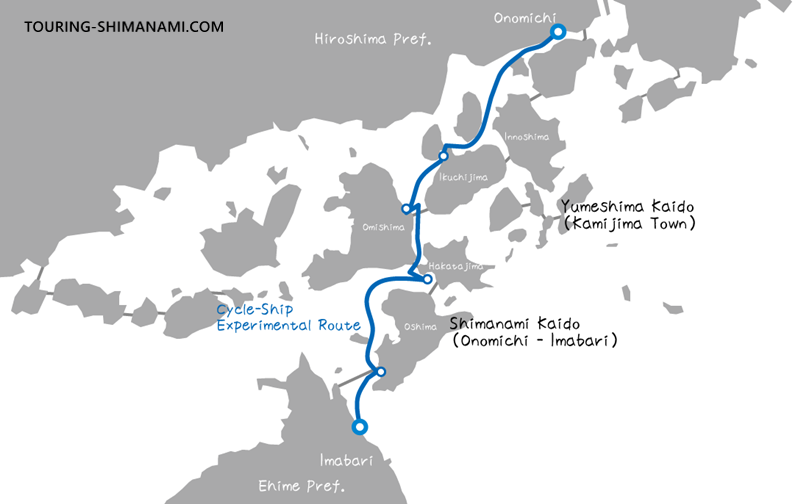
However, the current revival trial route doesn’t include the islands of the Yumeshima Kaido, so please keep in mind that it doesn’t simply take over the Geiyo Kisen route. Looking at the reasons reported for the withdrawal, I suspect other shipping companies are in similar situations. I feel that keeping routes running, including with the involvement of local governments, isn’t easy.
I’ve put together the routes that are commonly used for Shimanami Kaido cycling right now in the article below, so please use it as a reference when planning your trip.
AD (Google AdSense)
For Those Cycling the Shimanami Kaido Before the Withdrawal
Finally, here are the points worth keeping in mind right now if you’re planning to cycle the Shimanami Kaido before the withdrawal.
The Route Is Expected to Run Until the End of March 2028
The reported withdrawal date is the end of March 2028. The boat is currently running 4 round trips a day, but the timetable could change before then. You still have time to work this route into your ride, so if you’re thinking of using it, I’d recommend checking the latest operating information.
It’s also a good idea to check the conditions for carrying bicycles in advance, so you can ride with peace of mind. Since there are only 4 round trips a day, it’s important to leave some breathing room in your itinerary around the departure time. In particular, if you’re thinking of crossing by boat from the Imabari side to the Yumeshima Kaido, planning it while the service is still running could be one option.
Check Future Transportation Updates as You Plan Your Trip
From now on, in addition to Geiyo Kisen’s official information, it seems a good idea to keep an eye on announcements from Kamijima Town, Imabari City, and others. Once a replacement route or cycle ship service is decided, I think the options for cycling trips will change.
Rather than assuming how you’ll get around after the withdrawal, I hope you’ll check the latest information and make a plan that feels comfortable for you.
Final Thoughts
Geiyo Kisen’s withdrawal isn’t simply news about one shipping company disappearing. I think it’s an event that touches on the transportation linking the islands, the daily life of local communities, and the way we travel by bike. The Shimanami Kaido is an area where combining boats with bridges lets you tour the islands more freely.
I’m hoping for good news from the talks on keeping the route and from the cycle ship developments, and I’ll continue to follow them. When there’s new information, I’ll update this article, too.
In this article, I’ve covered the news of Geiyo Kisen’s withdrawal and what it means for Shimanami Kaido cycling. The biggest appeal of the Shimanami Kaido is that even beginners can enjoy cycling with peace of mind. You’ll find more detailed information on cycling the Shimanami Kaido on the page below, so please take a look.