
I visit Mt. Hirakiyama Park on Hakatajima Island every year during cherry blossom season. My most recent visit was in 2026. In this article, I share firsthand details on peak bloom timing, crowds, parking, access, and how manageable the climb is by bicycle.
Hi, I’m Yuki KAWAI — a touring cyclist based along the Shimanami Kaido. Having cycled this route more than 300 times, I created this site to share practical, experience-based tips for anyone planning a cycling trip here. I hope it helps you make the most of one of Japan’s most beloved cycling destinations.
One of the Best Viewpoints on Shimanami Kaido
When spring arrives, the islands of Shimanami Kaido begin to change color. Cherry blossoms bloom along the seaside roads, and as white and pink petals start to dot the hillsides, my legs somehow feel a little lighter on the pedals.
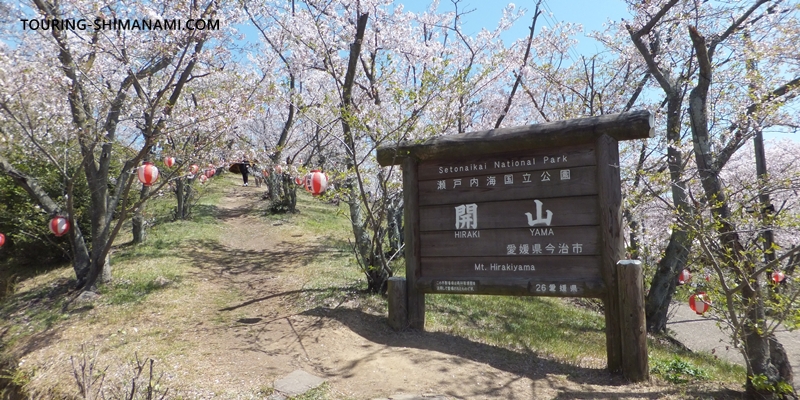
There are several spots along Shimanami Kaido where you can enjoy cherry blossoms in spring. Among them, the place I most want people to visit at least once is Mt. Hirakiyama Park (開山公園) on Hakatajima Island. Around 1,000 cherry trees grow here, and the sight of an entire mountainside turning soft pink is a landscape that has been cherished by locals for generations.
| Hakatajima Island | Mt. Hirakiyama Park |
|---|---|
| Peak Bloom | Late March to early April (slightly later than central Imabari) |
| Cherry Trees | Approx. 1,000 |
| Highlights | A panoramic viewpoint where you can look down on cherry blossoms from above |
| Crowds | Very crowded during cherry blossom season — cars can wait over an hour for parking. |
| Parking | Approx. 150 spaces (tends to fill up quickly) |
| By Bicycle | Reasonably accessible; beginners can take on the challenge. |
In this article, I share details based on my visit to Mt. Hirakiyama Park by bicycle on April 8, 2026 — including what makes it special and what you should know before you go.

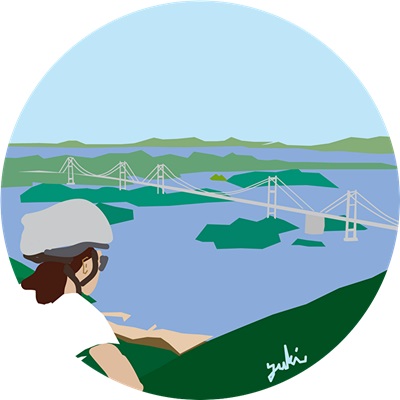
Out of all the viewpoints along the Shimanami Kaido, I think this is the best place if you really want to feel the Seto Inland Sea.
AD (Google AdSense)
Cherry Blossoms at Their Best: Late March to Early April
Mt. Hirakiyama (開山, pronounced “Hirakiyama”), located in the northwestern part of Hakatajima Island, rises to an elevation of 148 meters (about 485 ft). At its summit lies Mt. Hirakiyama Park.
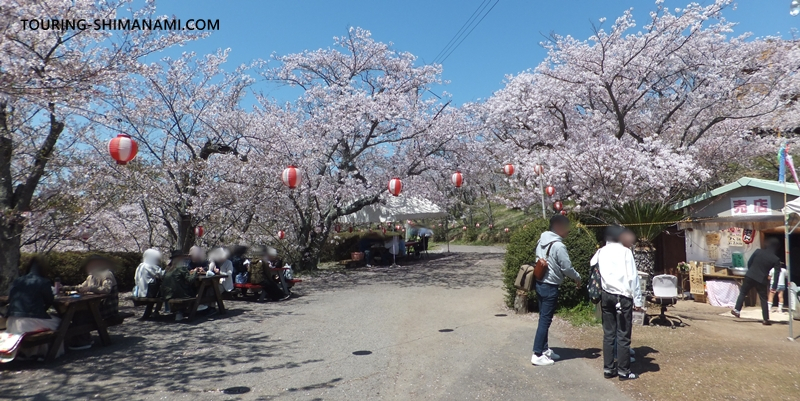
Among the viewpoints along Shimanami Kaido, Mt. Kirosan on Oshima Island (307m) and Mt. Sekizen on Iwagijima Island (370m) are especially well known. Mt. Hirakiyama is lower in elevation than these — but it’s famous as the premier cherry blossom destination on Shimanami Kaido.
| Viewpoint | Mt. Kirosan | Mt. Kareiyama | Mt. Hirakiyama | Mt. Shiratakiyama | Mt. Takamiyama | Mt. Sekizensan |
|---|---|---|---|---|---|---|
| Island | Oshima | Oshima | Hakatajima | Innoshima | Mukaishima | Iwagijima |
| Elevation | 307m | 232m | 148m | 227m | 283m | 370m |
| Climb Distance | 3km | 2.5km | 1.8km | 1.6km | 2km | 4km |
Even outside of cherry blossom season, the panoramic view of the Seto Inland Sea from the summit is well worth the climb.
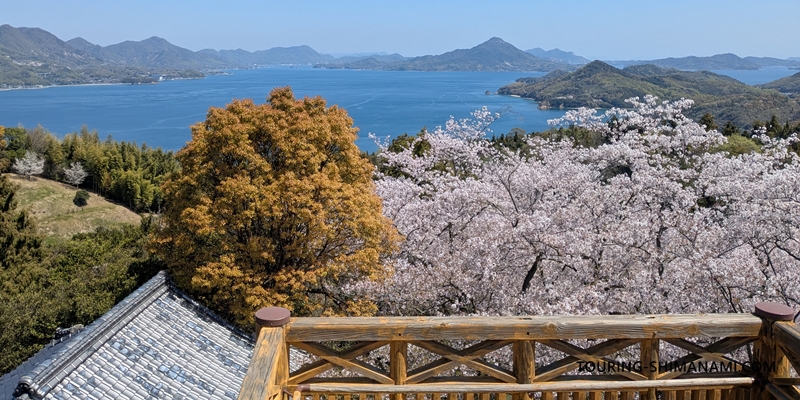
The park is home to around 1,000 cherry trees, mainly Somei Yoshino (a classic Japanese variety known for its soft, pale pink blooms), along with several other varieties. When they reach full bloom, the mountaintop is enveloped in a gentle wash of pale pink — beautiful whether admired from a distance or up close beneath the branches.
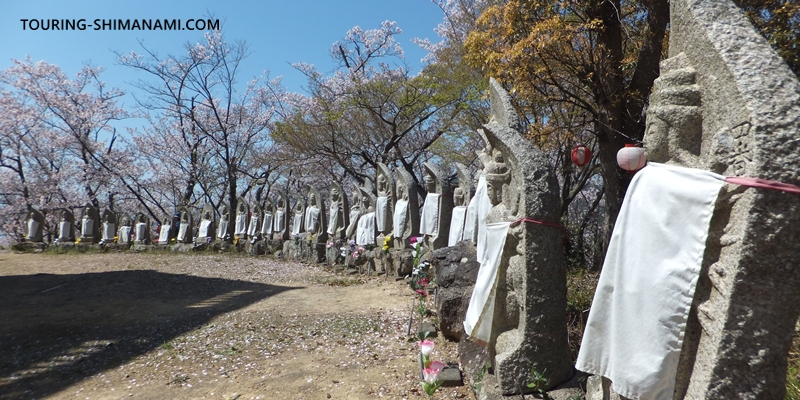
The history of this beloved cherry blossom spot dates back to 1952, when a statue of Kannon — a Buddhist figure of mercy and compassion — was donated to the site. The following year, local residents donated cherry trees and planted them in large numbers, and that is considered the origin of the park. Over time, the area was designated as part of Setonaikai National Park, and observation decks and forest roads were developed, giving Mt. Hirakiyama Park the form it has today. These are truly cherry trees that have been nurtured by the local community over generations.
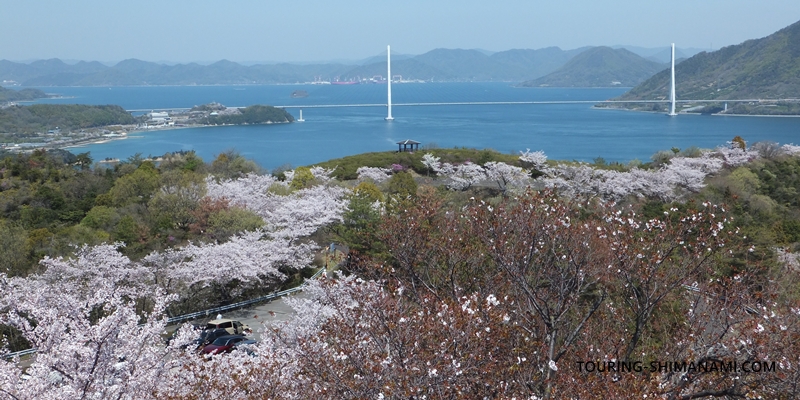
Peak bloom is typically from late March to early April. Because of its location at 148 meters elevation surrounded by sea, Mt. Hirakiyama tends to reach peak bloom about 4 to 7 days later than the official sample trees in central Imabari or Matsuyama. In an early spring year, peak bloom may arrive by the end of March, while in a later year you may still enjoy the blossoms into mid-April. I’d recommend checking social media and local news for the latest updates just before your visit.

Once the cherry blossoms start to bloom, lots of fresh posts show up on social media, so it’s pretty easy to check the latest conditions.
AD (Google AdSense)
A Sweeping View from a Three-Story Wooden Observation Deck
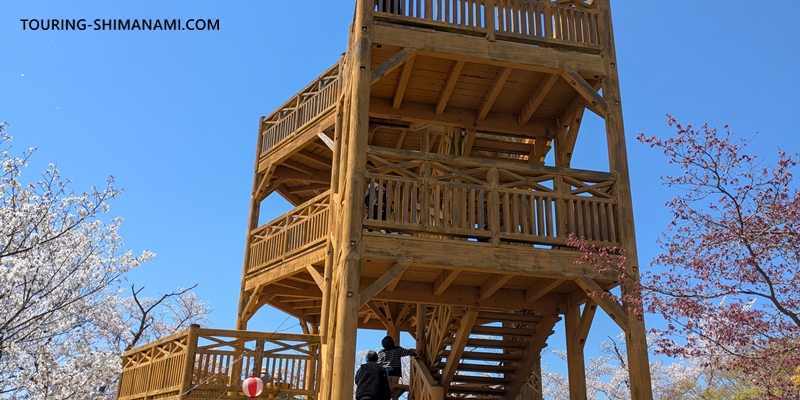
The highlight of Mt. Hirakiyama Park is the view from a three-story wooden observation deck near the summit.
From here, you can take in three of Shimanami Kaido’s bridges all at once: Hakata-Oshima Bridge, Omishima Bridge, and Tatara Bridge. The layered islands of the Seto Inland Sea spread out between them, and on a clear day, you can even spot Mt. Ishizuchi — the highest peak in western Japan — rising from the Shikoku Mountains in the distance.
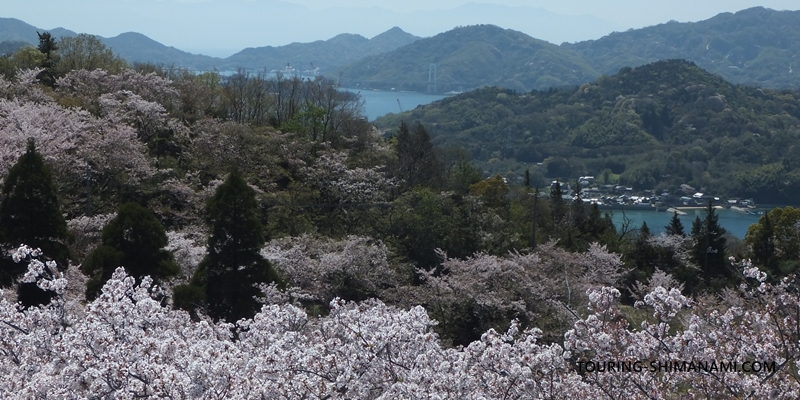
This view is stunning even without cherry blossoms — but when the trees are in full bloom, you can look down from the observation deck onto a sea of cherry blossoms spread out below you, a perspective you rarely get to experience. It’s almost like standing on a cloud of cherry blossoms. This is truly a view you can only encounter during this brief season of the year.
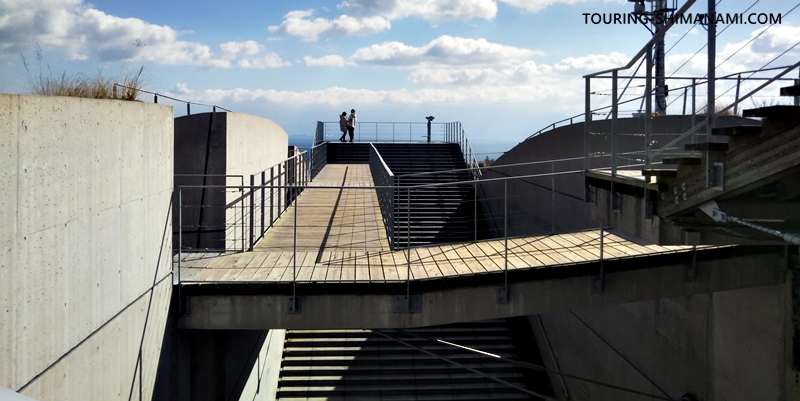
※ The photo above is of Mt. Kirosan observation deck on Oshima Island, not Mt. Hirakiyama Park.
Shimanami Kaido has several other wonderful viewpoints — Mt. Kirosan, Karei-yama, and Mt. Shiratakiyama are all well worth a visit. Among them, Mt. Hirakiyama Park is the one I’d most recommend to beginner cyclists. It offers relatively easy access and still delivers breathtaking scenery, which is why I personally consider it the top viewpoint for those new to cycling on Shimanami Kaido.
Evening illuminations are also held annually, so you can enjoy the cherry blossoms at night as well. In 2026, the illuminations were held from April 1–15, from approximately 6:30 PM to 10:00 PM. The nighttime atmosphere at Mt. Hirakiyama Park is a completely different experience from the daytime — well worth a visit if you have the chance.
The mountain road gets completely dark at night, so I wouldn’t recommend cycling there after sunset. It’s much better to go by car.
AD (Google AdSense)
A Hanami Spot Loved by Locals
Mt. Hirakiyama Park has more to offer than just cherry blossoms and a great view. The park also has a 36-meter long slide and playground equipment, making it a place where families with young children can enjoy hanami (cherry blossom viewing) with something extra for the kids.
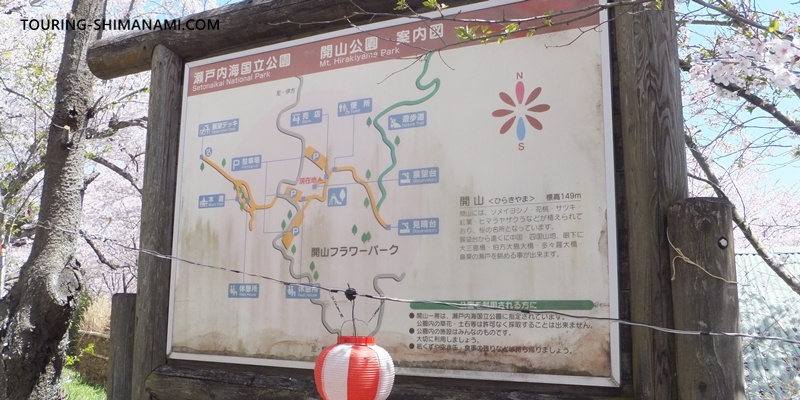
Benches and tables are set up throughout the park, and there are open spaces where visitors can spread out a tarp for a relaxed picnic under the blossoms. Many people were simply sitting back and soaking in the atmosphere at their own pace. There are also public restrooms in the park, though they are a bit dated.
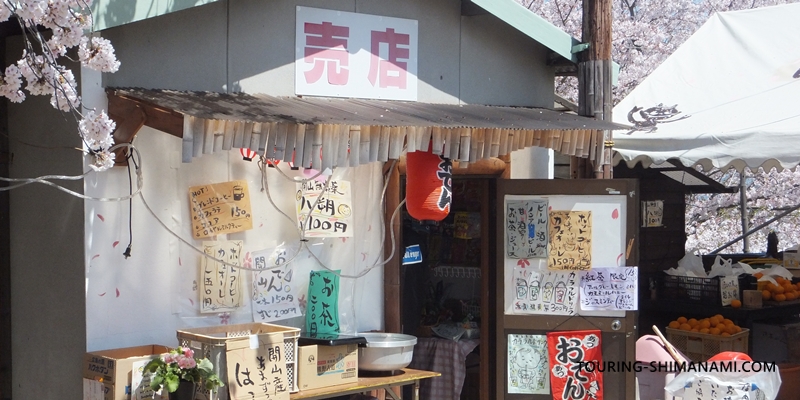
There was a small food stall in the park selling oden (a Japanese dish of fish cakes, tofu, and vegetables simmered in a light broth), shaved ice, drinks, and other snacks, giving it a lively, festival-like atmosphere. However, since there are no supermarkets or convenience stores near the park, I’d recommend packing your own drinks and lunch before heading up. If you’re coming by bicycle and want to pick something up along the way, the Life Shop on Oshima Island, the supermarket on Hakatajima Island, or the roadside station Hakata S.C. Park (道の駅 伯方SCパーク) are all good options.
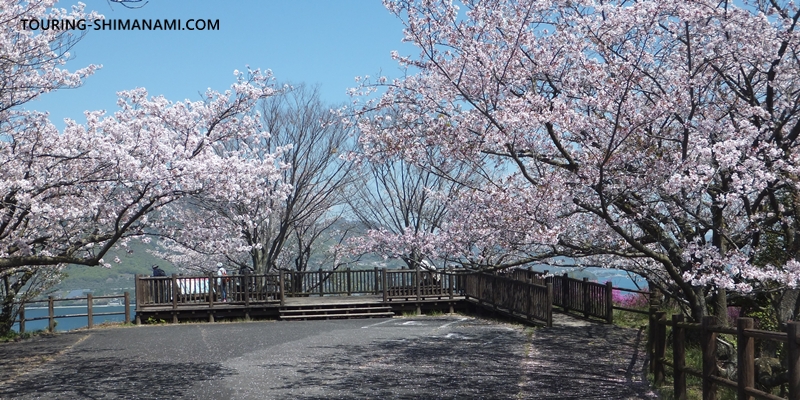
The wooden observation deck at the summit has a staircase structure, which may be difficult for wheelchair users or those with mobility concerns. For those visitors, I recommend the Tatara Bridge-side viewing deck, which can be reached via a walking path from the central parking area. You can drive quite close to it along the Tsutsuji Road (つつじロード), and there are fewer stairs, making it a more relaxed way to enjoy the scenery.
From the observation deck surrounded by cherry blossoms, you can enjoy sweeping views of the Tatara Bridge, Omishima, and Ikuchijima.
AD (Google AdSense)
On-Site Report: April 8, 2026
Chasing Cherry Blossoms from Central Imabari to Hakatajima
I set out from central Imabari in the morning. The route — crossing the Kurushima Kaikyo Bridge to Oshima Island and continuing on to Hakatajima to reach Mt. Hirakiyama Park — covers about 30 km one way and takes around 3 hours of actual riding time. On this day, the wind was calm and the sky was a perfect, unbroken blue. It felt like the ideal day had been prepared just for a cherry blossom cycling trip.
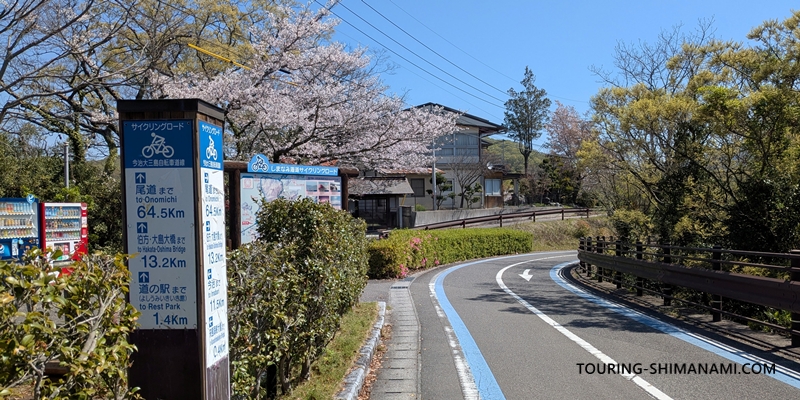
Along the cycling road from central Imabari toward the Kurushima Kaikyo Bridge, there is an area known as Itoyama. Cherry trees bloom all along the road leading up to the bridge, and the contrast between the blue painted cycling guideline (Blue Line) on the road surface and the pink cherry blossoms was truly beautiful. I couldn’t help stopping my bike to take photos. With the Kurushima Kaikyo Bridge as a backdrop, this spot at Itoyama is one I’d especially recommend for capturing a quintessential Shimanami Kaido cherry blossom shot.
More Cherry Blossoms Along the Way on Oshima and Hakatajima
After crossing the Kurushima Kaikyo Bridge and landing on Oshima Island, I headed north over Miyakubo Pass. Cherry trees were in bloom near the top of the pass as well. The combination of the satisfaction of cresting the hill and the cherry blossoms greeting you at the top was a genuinely pleasant experience.
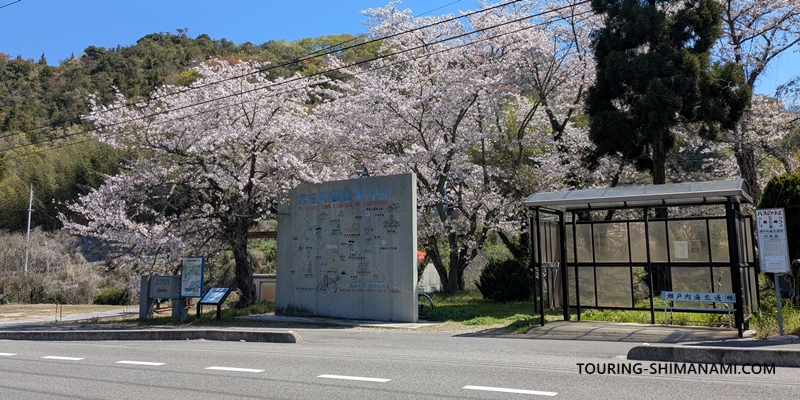
After crossing Hakata-Oshima Bridge and arriving on Hakatajima Island, I could see wild mountain cherry trees (yamazakura) dotting the hillsides here and there. It’s a different kind of beauty from a neatly lined avenue of cherry trees — more humble, blending naturally into the rural hillside scenery. I really love that look.
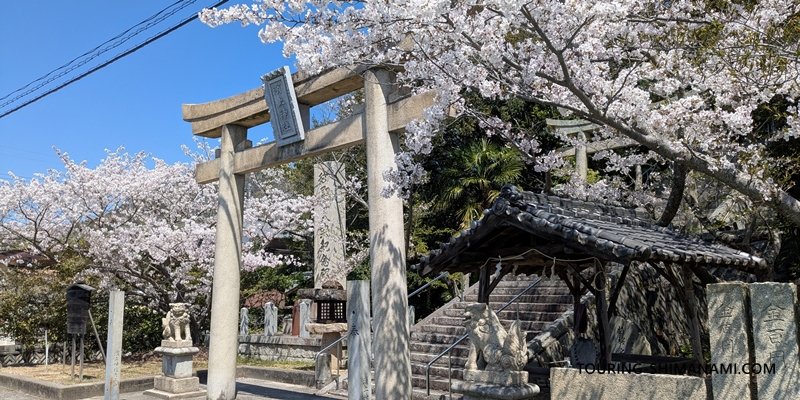
As I passed along the main route on Hakatajima, the cherry trees lining the approach to Hamakami Shrine happened to be in full bloom, and I found myself stopping without even thinking about it. It isn’t a well-known tourist landmark, but these kinds of unexpected encounters are exactly what makes bicycle travel so special.
I stopped for a break at the roadside station Hakata S.C. Park. Right on the beach, it was the perfect spot to enjoy the famous “Hakata Salt Soft Serve Ice Cream” — made with Hakatajima Island’s traditionally produced sea salt — while gazing out at the sea. Hakatajima has long been known for its salt-making, and “Hakata no Shio” (Hakata salt) is a well-known brand throughout Japan. It was absolutely delicious.
Climbing to Mt. Hirakiyama Park
After riding a little further from the roadside station, the entrance to the Mt. Hirakiyama Park climb came into view. The road to the summit is one-way: the entrance is from the Ikata side. Directional signs were posted along the route, so I had no trouble finding the starting point.
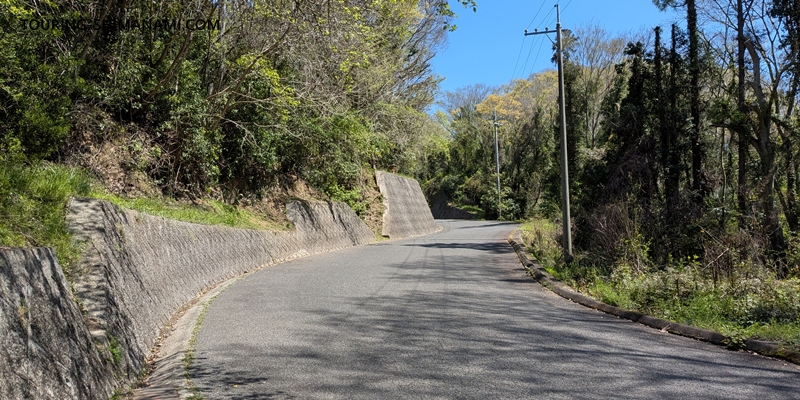
Rather than one continuous climb, the route winds around the mountain in a series of small ups and downs. I shifted to an easy gear and took it nice and slow. It was sunny and the temperature was rising, so I worked up a bit of a sweat on the way up. For a spring hillclimb, wearing layers you can easily take off is the way to go — overdress and you’ll overheat quickly.
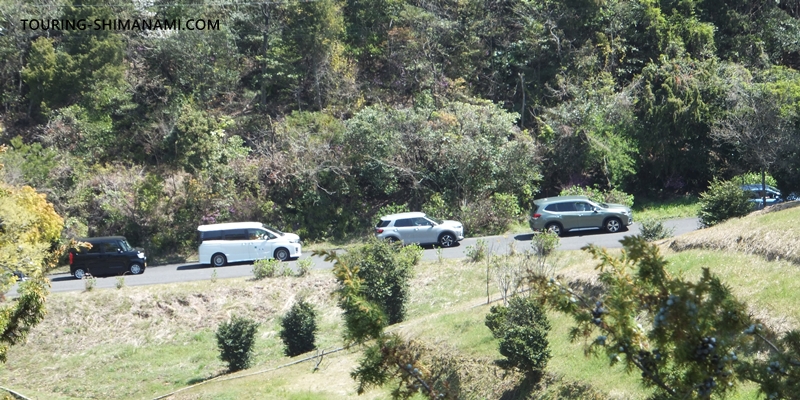
The parking area near the summit was incredibly crowded — even on a weekday, I counted more than 40 cars queued up waiting for a space. Bicycles and motorcycles, however, are guided to a dedicated parking area and can pull in without any wait, regardless of the car traffic. If you’re visiting Mt. Hirakiyama Park during cherry blossom season, coming by bicycle is definitely the way to go.
The View from the Summit
Some of the cherry trees near the summit were just beginning to show leaves, but overall the timing was perfect — right at full bloom.
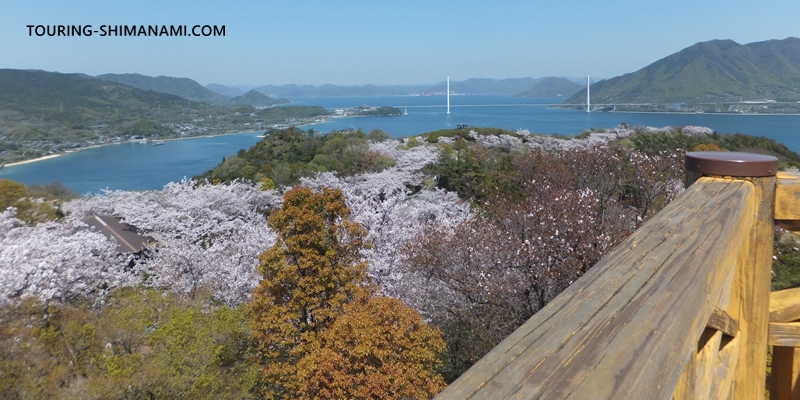
Climbing up to the observation deck, the view that spread out before me exceeded my expectations. Hakata-Oshima Bridge, Omishima Bridge, and Tatara Bridge were all visible at once, layered with the island scenery of the Seto Inland Sea and a full sweep of cherry blossoms in the foreground — a view only possible during this brief season. I couldn’t help thinking: “This might be the most beautiful week of the year on Shimanami Kaido.”
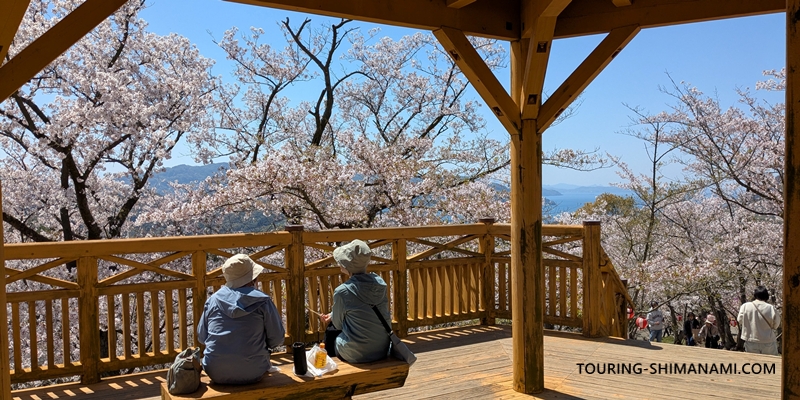
The park was full of people enjoying the cherry blossoms, mostly locals. Looking at the license plates on the parked cars, the vast majority were from Ehime Prefecture. Visiting in person, you really get a sense of just how deeply loved this spot is by people throughout the Shimanami Kaido area.
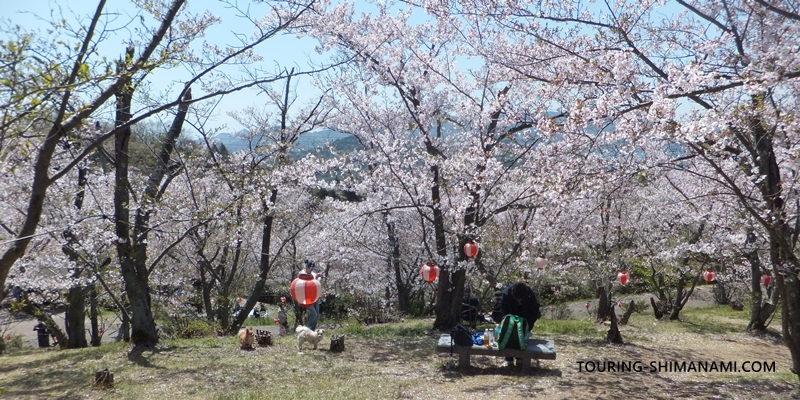
It happened that a nearby elementary school was holding its entrance ceremony that day — in Japan, the school year begins in April, and these ceremonies often fall right in the middle of cherry blossom season. I often saw young children who appeared to be starting first grade, along with their families, taking commemorative photos under the cherry trees. It was a warmly touching spring scene, a reminder of just how special this place is to the local community.
I go cycling dozens of times a year, but days with weather this perfect are pretty rare!
AD (Google AdSense)
What to Know Before You Visit
One-Way Road to the Summit
The road to the summit of Mt. Hirakiyama Park is one-way. The entrance is from the Ikata side, and the exit leads down toward Kumakuchi Port. Cyclists follow the same route as cars, so I’d recommend checking the map in advance to make sure you don’t miss the entrance.
Directional signs are posted along the route, so as long as you follow them carefully, you shouldn’t have any trouble finding your way.
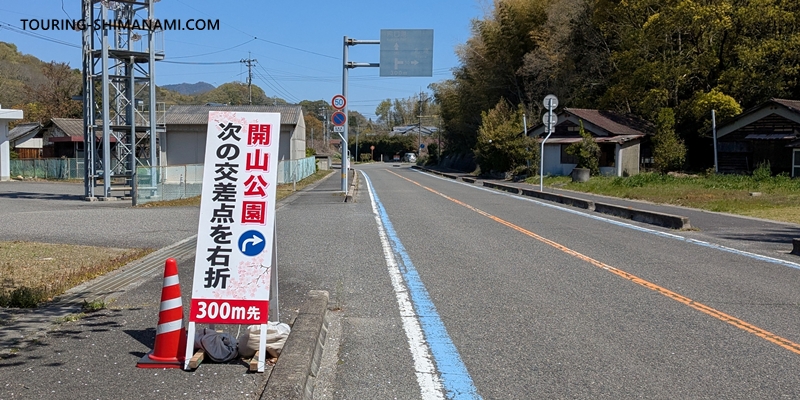
The descent involves a series of winding turns, and some sections have narrow road widths. When cycling downhill in particular, please take it slowly and carefully to avoid building up too much speed.
Parking and Crowds
There are three parking areas near the summit with a combined capacity of around 150 vehicles. Parking is free of charge. During cherry blossom season — especially on weekends — the lots fill up quickly and long queues can form. Even on a weekday morning I saw more than 40 cars waiting for a space, so I’d recommend building some extra time into your schedule.
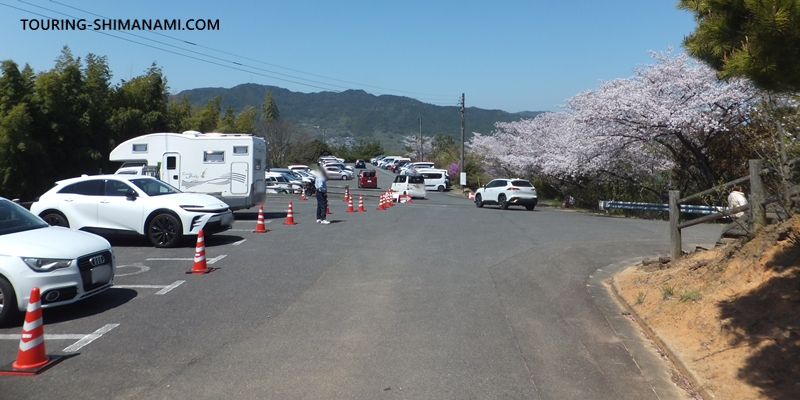
Bicycles and motorcycles can park without waiting in the car queue, which makes cycling a very comfortable way to visit during the busy cherry blossom season. During this season, parking attendants are stationed near the summit and will direct cyclists and motorcyclists to the dedicated parking area.
The evening illuminations are typically held from around April 1–15, approximately 6:30 PM to 10:00 PM. If you’re planning to visit for the night cherry blossoms, please allow plenty of time in your schedule.
Cycling to the Summit
The climb to Mt. Hirakiyama Park is relatively manageable compared to other viewpoints on Shimanami Kaido, such as Mt. Kirosan observation deck (307m) or Karei-yama observation deck (approx. 200m), given its elevation of 148 meters. The designated bicycle parking area is at around 135 meters elevation, and from there you walk the remaining short distance to the observation deck.
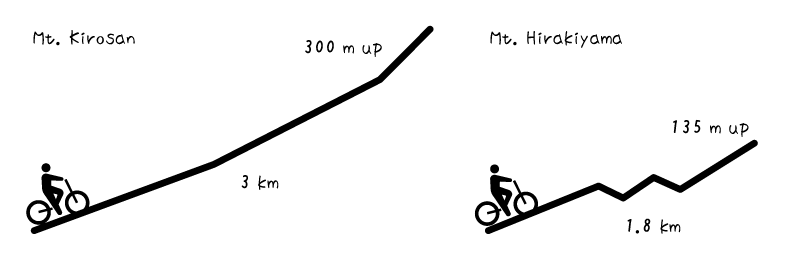
That said, some sections of the road are quite steep, so if you’re a beginner riding a rental bicycle, it’s a good idea to keep in mind the option of walking your bike up the steeper parts. Electric-assist bicycles are also available as rentals on Shimanami Kaido, and with one of those, getting to the summit is significantly easier than on a standard cross bike or city bike.

Take Extra Care on the Descent
For beginner cyclists heading to Mt. Hirakiyama, the part that requires the most care isn’t the climb — it’s the descent on the way back. The downhill section toward Kumakuchi Port has steeper gradients, a narrower road, and many winding curves. There are several blind corners, and some parts of the road surface are uneven. Accidents do happen here, so please apply both brakes steadily and descend very slowly. Also be mindful of cars and motorcycles coming up the hill from below.
Getting There Without a Car
By car, it’s approximately 10 minutes from Hakatajima IC on the Nishiseto Expressway (Shimanami Kaido).
By public transport, take a bus from JR Imabari Station toward Omishima and get off at Hakatajima bus stop (伯方島バス停), then transfer to the Hakatajima Loop Line (Kitaura route / 北浦廻り) and get off at “Kumakuchi” (熊口). From there, it’s about a 20–30 minute walk to the park. There are approximately 11 buses per day on this route. Payment is by cash only — IC transit cards are not accepted, so please bring coins and small bills. Timetables are subject to change, so please check the latest schedule before you travel.
Another option for cyclists is to rent a bicycle at Imabari Station, ride to Hakatajima Island, and return the bike at Hakata S.C. Park, then take the local bus from Hakatajima bus stop. The cycling distance from Imabari to Hakatajima Island is about 30 km, which takes approximately 3 hours at a leisurely pace.

Maps You Should Get in Advance
“CycloTourisme Shimanami,” which has been active in cycle tourism and regional promotion for nearly 20 years along the Shimanami Kaido, publishes guidebooks and maps. The map is also available in English and is extremely popular because it is the most detailed cycling-specific map in this region.
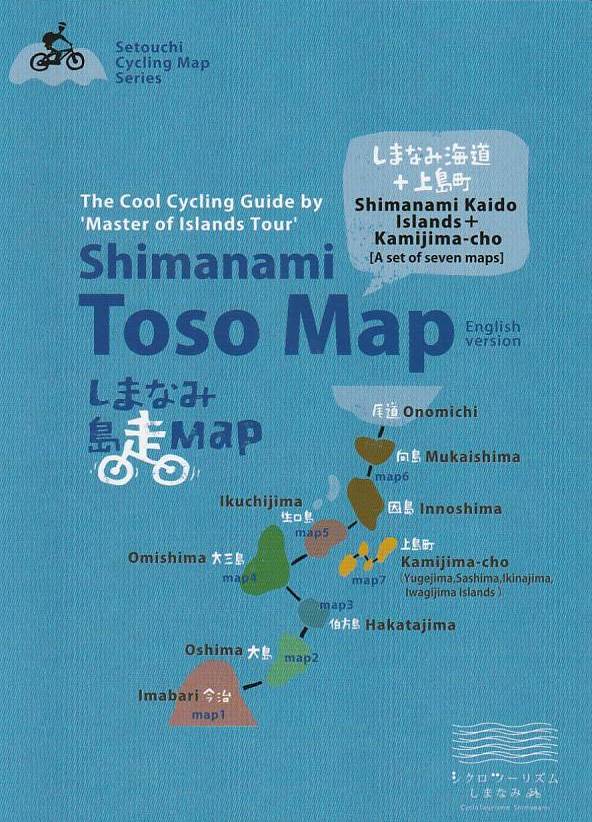
This product comes with a set of seven maps, each with a fairly detailed map for each island. I believe that getting your hands on this map will change your experience here. It can be purchased on Amazon.co.jp, and you can also buy it locally at Guesthouse CYCLONOIE in front of Imabari Station.
Until Next Year, to See This View Again
Cherry blossom season is short. Even though the blossoms return to the same place each year, the view looks a little different every time — depending on the wind, the color of the sky, and the time of day you happen to arrive. That’s the mysterious charm of cherry blossoms.
The cherry trees at Mt. Hirakiyama Park have been lovingly tended by the local community over many years. I hope that one day you’ll have the chance to visit this place yourself and see, with your own eyes, the view from the observation deck where the layered islands of the Seto Inland Sea and a full spread of cherry blossoms come together. Please enjoy the beautiful spring on Shimanami Kaido at your own pace.
On this page, I’ve shared details about Mt. Hirakiyama Park and its cherry blossoms on Hakatajima Island. One of the greatest features of Shimanami Kaido is that even beginner cyclists can enjoy it with confidence. For a comprehensive guide to cycling Shimanami Kaido, please visit the page below.