
![[Title] Cycling across Onomichi Bridge from Onomichi to Mukaishima on the Shimanami Kaido](https://touring-shimanami.com/wp-content/uploads/2025/07/onomichibrdge-ogp.jpg)
The cycling route of the Shimanami Kaido between Mukaishima and Onomichi is a bit special. While bicycles are technically allowed on the Onomichi Bridge, it’s actually recommended that cyclists take a ferry instead. This article explains the reasons, along with photos of the sidewalks and road shoulders.
Hi, I’m Yuki KAWAI — a touring cyclist based along the Shimanami Kaido. Having cycled this route more than 300 times, I created this site to share practical, experience-based tips for anyone planning a cycling trip here. I hope it helps you make the most of one of Japan’s most beloved cycling destinations.
How to Travel Between Onomichi and Mukaishima
Onomichi bridge and Shin-Onomichi bridge
Most of the bridges along the world-famous Shimanami Kaido cycling route feature dedicated pedestrian and bicycle paths, or scooter lanes. This makes the route not only a convenient highway connecting Honshu and Shikoku but also an attractive destination for touring the Seto Inland Sea by bicycle or scooter.
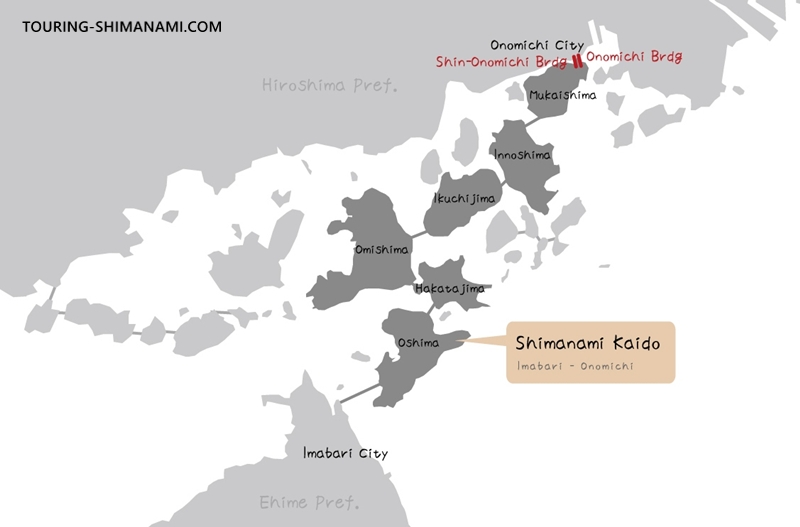
However, the Onomichi Bridge and the Shin-Onomichi Bridge, which connect Onomichi and Mukaishima, are exceptions.
Travel guides issued by local governments and well-known guidebooks like “Shimanami TOSO BOOK” recommend using a ferry instead of the Onomichi Bridge when traveling by bicycle. In fact, most cyclists and travelers on the Shimanami Kaido choose to cross between Mukaishima and Onomichi by ferry.
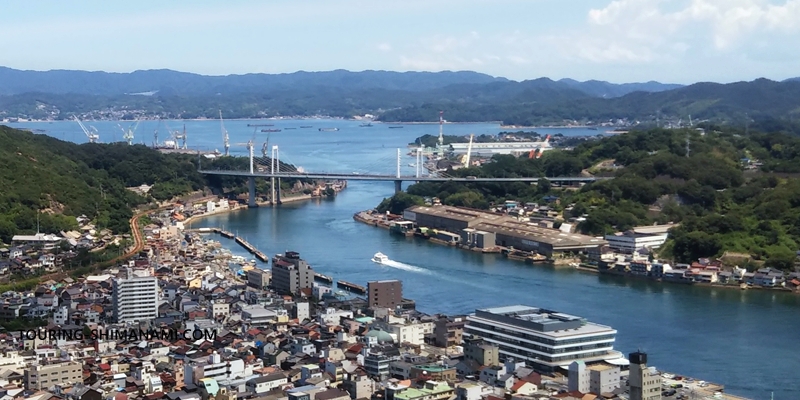
This photo was taken from the Senkoji Park observatory and shows both the Onomichi Bridge and the Shin-Onomichi Bridge. Though it’s hard to see at first, the two bridges run side by side over the Onomichi Channel between Onomichi and Mukaishima. The Shin-Onomichi Bridge (closer to the camera), opened in 1999, is a highway bridge exclusively for motor vehicles. As with any expressway, bicycles and pedestrians are strictly prohibited.
| Onomichi ~ Mukaishima | Shin-Onomichi Bridge | Onomichi Bridge |
|---|---|---|
| Road Classification | Expressway (Nishi-Seto Expressway) | General Road (National Route 317) |
| Opened | 1999 | 1968 |
| Bicycles | Prohibited | Allowed |
The bridge further in the background is the older Onomichi Bridge, completed in 1968. At the time, it was a toll bridge called “Onomichi Toll Road,” and was considered a large cable-stayed bridge for its era. Today, it’s part of National Route 317 and free to use. Since it’s a public road, bicycles and pedestrians are allowed to cross. In fact, historical records show that the toll for pedestrians was free and bicycles were charged 10 yen—suggesting that cyclists were always expected to be among its users instead of relying solely on ferries.
- Why cycling across Onomichi Bridge is not recommended
- How to use the ferry between Mukaishima and Onomichi
Legally, it is OK for bicycles to pass through on Onomichi Bridge, but in reality….
AD (Google AdSense)
On-site Report: Is That Bridge Dangerous?
Why cycling on the bridge is not recommended
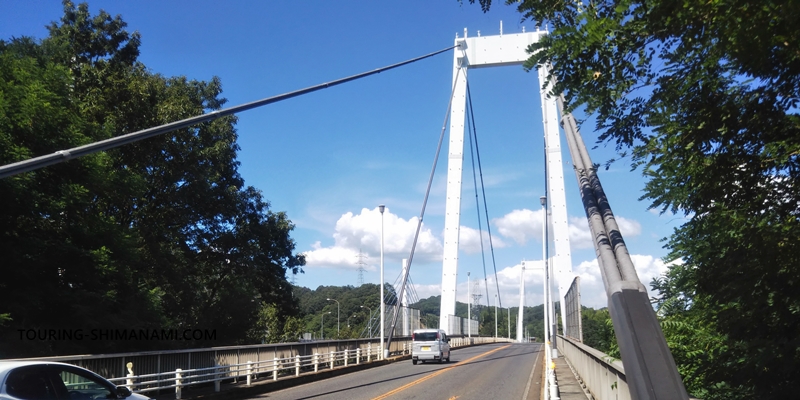
When the Onomichi Bridge opened in 1968, the idea of a Shimanami Kaido cycling route hadn’t yet been conceived. Unlike other bridges on the route, it wasn’t designed with a bike path or separate lane for cyclists and pedestrians. The bridge is narrow in many parts and has heavy vehicle traffic. That’s why, for safety reasons, it’s highly recommended to use the ferry instead of cycling across the Onomichi Bridge. In short, cycling on the bridge isn’t prohibited, but it’s strongly discouraged due to safety concerns.
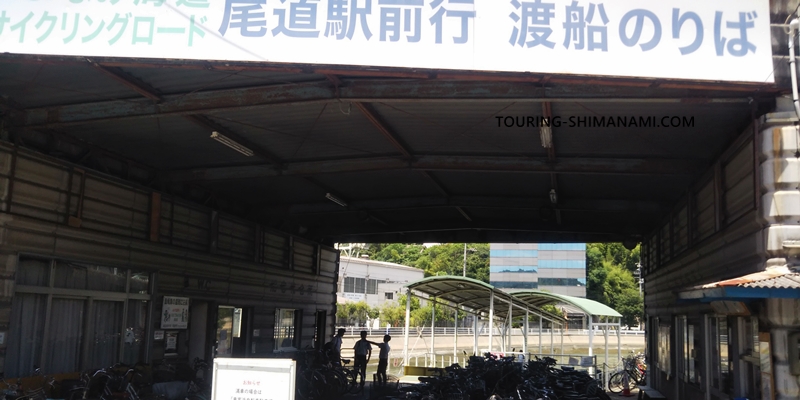
If you’re cycling from the Imabari side along the Shimanami Kaido’s blue line route markers, you’ll naturally be guided to the ferry terminal headed to Onomichi Station. So in most cases, you don’t even need to think about whether or not to enter the Onomichi Bridge. However, if you take an alternate route or aren’t aware of the ferry in advance, you might end up on the Onomichi Bridge by mistake.

The Onomichi bridge is narrow
To understand how narrow it is, just take a look at the photos. You might be surprised to learn that bicycles used to be charged 10 yen to cross this bridge—it clearly wasn’t designed with cyclists in mind.
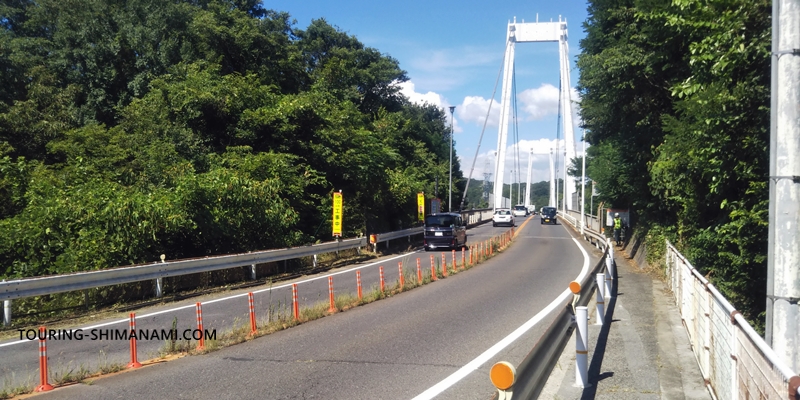
To approach the Onomichi Bridge, you’ll climb a sloped road from either the “Onomichi Bridge Entrance” intersection on National Route 2 (Onomichi side) or the “Nibangata” intersection on National Route 317 (Mukaishima side). These approach roads have almost no sidewalks, and the road shoulders are extremely narrow. The photo above shows the widest sidewalk on the Mukaishima side—it’s already tight. On the opposite side, there’s no sidewalk at all.
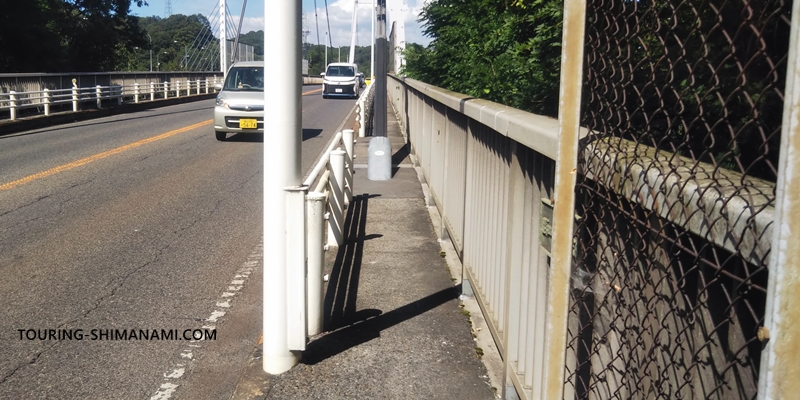
The bridge itself has sidewalks on both the left and right sides. While walking across is technically possible, it feels quite dangerous with cars passing so close. Honestly, the scariest part is the approach, where sidewalks are either missing or too narrow. During our visit, I didn’t see a single pedestrian or cyclist using the bridge—only some construction workers were present.
Riding on the roadway
As you can see from the photo, Onomichi Bridge is not only narrow on the bridge itself, but also on the approach roads leading up to it. Each side has just one lane, and the shoulder is extremely narrow. From a local perspective, it’s very rare to see cyclists using this bridge, so if someone is riding a bicycle here, it would honestly come as a surprise.
In addition, this section has an orange center line, which means crossing the line to overtake is prohibited. If a cyclist is riding on the roadway, it is very difficult for cars to pass safely while maintaining a sufficient lateral distance (at least 1.5 meters is recommended) without crossing into the opposite lane.
Even on the roadway, it is fair to say that riding a bicycle safely across Onomichi Bridge is currently quite difficult. If you absolutely need to cross the bridge—such as when the ferry is not operating—it is better to get off your bike and walk along the pedestrian path.
AD (Google AdSense)
What it’s Actually Like to Cross Onomichi Bridge
The sidewalk is narrow, and the cables get in the way
During my visit, I wasn’t on a bicycle, so I decided to cross Onomichi Bridge on foot. The sections with the bridge cables felt especially narrow, and I found that even walking across with a bicycle or a large suitcase would feel quite cramped.
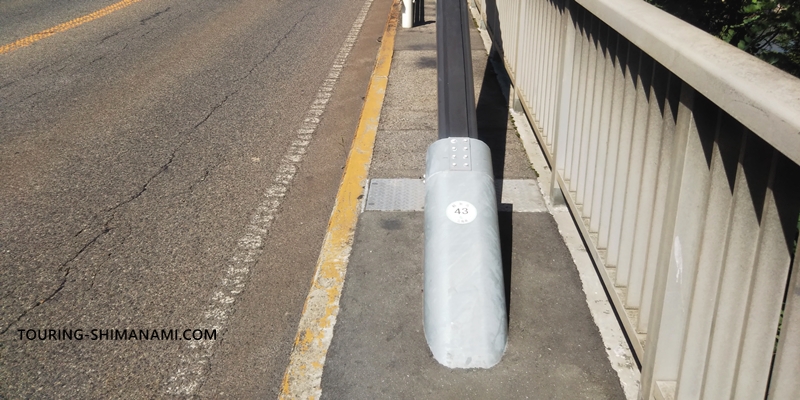
When it comes to the sidewalk, it doesn’t even compare to the other bridges on the Shimanami Kaido—it felt quite dangerous to ride a bicycle here. This is because the cables of this cable-stayed bridge actually rise up from the middle of the sidewalk. Even when pushing a bicycle, they get in the way and can be quite stressful to navigate. This situation is the same on both sides of the bridge.
It’s hard to tell where to go
Another issue is navigation. On the approach from the Onomichi side to Onomichi Bridge, there is a junction that connects to the Route 2 bypass, which is a motor-vehicle-only road. This creates a risk of accidentally entering a road where bicycles and pedestrians are not allowed. The Onomichi side, in particular, has a complex loop structure, making it quite confusing for first-time visitors. To be honest, even after actually walking the route myself, I’m still not entirely sure which path was the correct one.
Heavy traffic and high speeds
This time, I walked along the sidewalk on the right-hand side. Even though the sidewalk is separated from the roadway by a curb and a guardrail, I still felt intimidated by the volume and speed of passing vehicles. With only one lane in each direction and a very narrow shoulder, cars felt extremely close as they passed by.
Onomichi Bridge serves as a main route connecting Honshu and Mukaishima, so there is a high volume of traffic, including everything from passenger cars to large trucks. For those traveling only between Onomichi and Mukaishima, using the expressway is inconvenient and requires a toll, so many locals and commercial drivers choose Onomichi Bridge rather than the Shin-Onomichi Bridge.
It also means a detour
In addition, if you are trying to get from central Onomichi—where Onomichi Station and the shopping street are located—to Mukaishima, going via Onomichi Bridge is quite a detour. This is because the bridge is located in Sannami-cho, on the outer edge of the Onomichi Channel. It’s about 3.5 km from Onomichi Station to the bridge.
Maps You Should Get in Advance
“CycloTourisme Shimanami,” which has been active in cycle tourism and regional promotion for nearly 20 years along the Shimanami Kaido, publishes guidebooks and maps. The map is also available in English and is extremely popular because it is the most detailed cycling-specific map in this region.
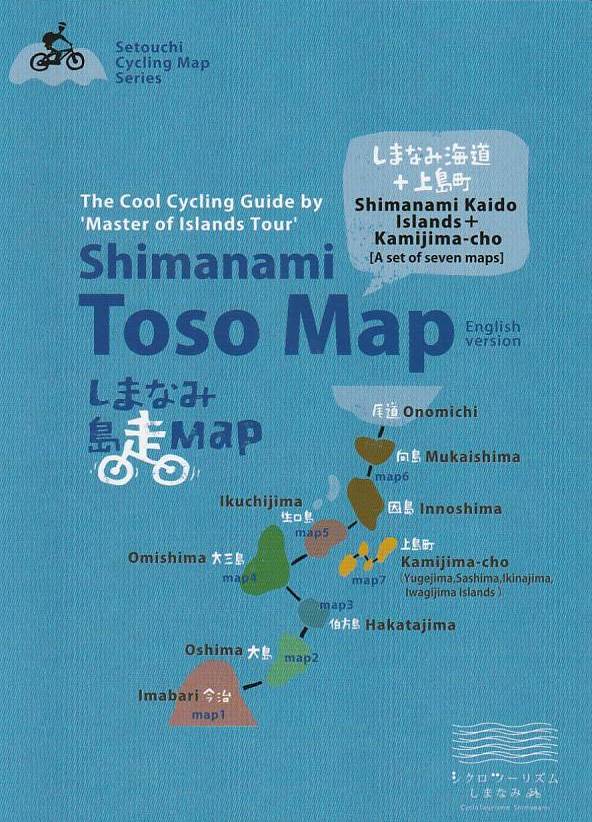
This product comes with a set of seven maps, each with a fairly detailed map for each island. I believe that getting your hands on this map will change your experience here. It can be purchased on Amazon.co.jp, and you can also buy it locally at Guesthouse CYCLONOIE in front of Imabari Station.
Taking a Ferry is the Best Option
Take advantage of the convenient and affordable ferry
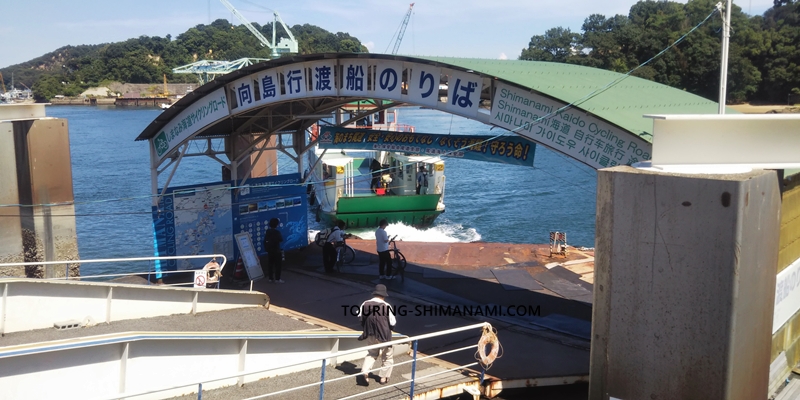
There are two ferry routes available to cross from Onomichi to Mukaishima. All of them allow bicycles, but the most convenient is the Ekimae Boat. You’ll find the terminal just to the left after exiting JR Onomichi Station and heading toward the sea. The fare is around 100 yen, including your bicycle. No tickets are needed—the crew will collect the fare onboard.
The two ferries between Onomichi and Mukaishima
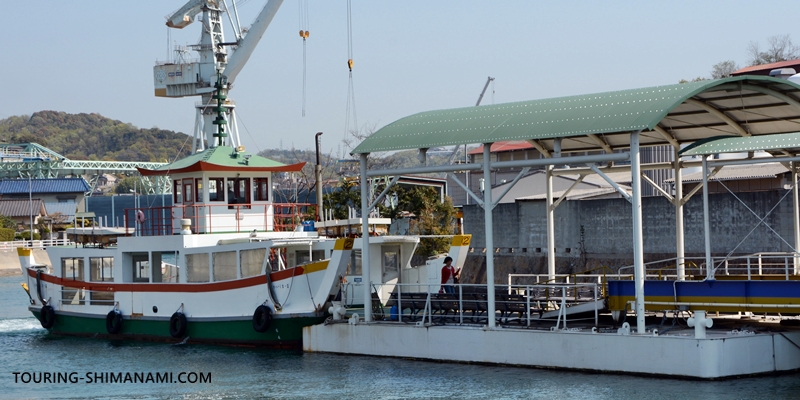
If you’re coming from the Mukaishima side, the Tomihama Pier will take you directly to Onomichi Station, assuming you’re following the Blue Line. None of the boats operate on fixed schedules, but they run frequently from early morning until evening. If you don’t see a boat when you arrive, just wait a few minutes. Taking the ferry is much safer and more relaxing than forcing your way across the Onomichi Bridge. Plus, it gives you a taste of local island life and adds charm to your journey. I highly recommend choosing the ferry.
| Ferry | Ekimae Boat | Kaneyoshi Ferry | Fukumoto Ferry |
|---|---|---|---|
| Route | In front of Station – Tomihama | Tsuchido – Kaneyoshi | Tsuchido – Koutajima |
| Notes | If you’re coming from Imabari following the main route, the Blue Line guides you to this boat. | This ferry has appeared in TV dramas and movies. It’s the farthest from Onomichi Station. | Note: Fukumoto Ferry service will end in March 2025. |
A two-day model course for completing the full route
One of the great features of cycling the Shimanami Kaido is how well the rental bike system and cycling routes are designed. This makes it accessible not only for experienced cyclists who bring their own bikes, but also for beginners who rent a bicycle. You can also choose to cycle just certain sections by combining your trip with ferries or buses, while many people aim to complete the entire route from Imabari to Onomichi.
If it’s your first time and you’re renting a bike, and you’d like to enjoy sightseeing on the islands along the way, I recommend taking a relaxed two-day trip to complete the full Shimanami Kaido route.
AD (Google AdSense)
Frequently Asked Questions
I’ve put together some of the most common questions I receive about cycling across Onomichi Bridge. I hope this helps ease any concerns for those visiting the Shimanami Kaido for the first time.
- QCan you cross Onomichi Bridge by bicycle?
- A
Onomichi Bridge is a regular road (National Route 317), so bicycles are not prohibited from using it.
However, when you actually visit and see the conditions for yourself, you’ll notice sections without sidewalks and many areas where the shoulder is extremely narrow. There is also a high volume of traffic, making it quite a challenging environment for cycling.
If your goal is to enjoy cycling the Shimanami Kaido safely, there’s no need to force yourself to take this route.
As many people do, using the ferry route is a much more comfortable and stress-free way to get across.
- QWhy doesn’t Onomichi Bridge have a dedicated cycling lane?
- A
Onomichi Bridge was opened in 1968.
At that time, there was no concept of a cycling route like the Shimanami Kaido we know today.As a result, dedicated space for cyclists and pedestrians was not sufficiently planned. While there is a sidewalk on the bridge itself, the approach sections leading to it are quite narrow and not particularly comfortable to use.
Given the limited space available, it’s unlikely that major improvements will be made in the future.
- QIs it safe if I walk my bicycle across?
- A
It is possible to walk your bicycle along the sidewalk.
However, when you actually try it, you’ll notice that the bridge cables are positioned near the center of the sidewalk, which can make it a bit difficult to pass through with a bike.In addition, the roadway feels very close, and vehicles pass by right next to you, which may feel intimidating depending on the person.
If you absolutely need to cross, it’s important not to rush and to proceed carefully while watching the surrounding conditions.
That said, I would still generally recommend using a ferry instead.
- QIf I don’t use Onomichi Bridge, how can I get to Mukaishima?
- A
The most common way to travel between Onomichi and Mukaishima is by a small local ferry.
When you head toward the waterfront from JR Onomichi Station, you’ll find several ferry terminals to Mukaishima nearby.
Also, along the Shimanami Kaido cycling route, there is a blue line painted on the road (known as the “Blue Line”), which naturally guides you to the ferry if you follow it.The fare is very affordable—around 100 yen including your bicycle—and the crossing takes just a few minutes.
The short ferry ride itself is also part of the travel experience.Enjoy the relaxed atmosphere of the Seto Inland Sea, and give it a try.
- QDo I need a reservation or check a timetable for the ferry?
- A
No reservation is required to use the ferry.
There isn’t a strict timetable either, as the boats run back and forth frequently at short intervals.Depending on timing, you might have to wait a few minutes, but long waits are very rare.
You also don’t need to buy a ticket in advance—you simply pay the fare after boarding.It’s very easy to use, so even first-time visitors can ride with confidence.
- QI’m worried about accidentally entering Onomichi Bridge
- A
Along the main Shimanami Kaido cycling route, there is a painted guide on the road known as the “Blue Line.”
By simply following this line, you will naturally be guided to the ferry terminal in front of Onomichi Station.For this reason, if you stay on the standard cycling route, there is very little risk of accidentally ending up on Onomichi Bridge.
If you’re starting your ride by renting a bicycle near Onomichi Station, the ferry terminal is right in front of you. As long as you know that “you take a ferry between Onomichi and Mukaishima,” you should have no trouble finding your way.
The road layout around the bridge on the Onomichi side is actually quite complex, with many junctions, so in a way, it’s harder to end up on Onomichi Bridge by mistake.
- QWhich bridge should I use if I’m driving to Mukaishima?
- A
There are two bridges between Onomichi and Mukaishima: Onomichi Bridge and Shin-Onomichi Bridge.
Shin-Onomichi Bridge is an expressway, so bicycles and pedestrians are not allowed. To access it, you need to use the Nishi-Seto Onomichi Interchange on the Onomichi side or the Mukaishima Interchange on the island side.
Onomichi Bridge, on the other hand, is a regular road and can be used for local travel. If you are simply going between Onomichi and Mukaishima, it is the most commonly used route.
This page explained why the Onomichi Bridge on the Shimanami Kaido is not recommended for cyclists. For more detailed information about cycling the Shimanami Kaido, please visit the link below.