
![[Title] Three Public Bathhouses! A Guide to the Differences Between the Day-Use Baths at Dogo Onsen](https://touring-shimanami.com/wp-content/uploads/2026/03/dogoonsene-ogp.png)
Visiting Dogo Onsen for the first time? This guide introduces the three main bathhouses—Honkan, Asuka-no-Yu, and Tsubaki-no-Yu—with tips on tickets, bathing etiquette, and how to visit after cycling the Shimanami Kaido.
Hello, I am Kawai, a cyclist living on the Shimanami Kaido, the most famous cycling routes in Japan. This page introduces Dogo Onsen in Matsuyama.
- Dogo Onsen in Matsuyama, Ehime
- What kind of hot spring is Dogo Onsen?
- Comparing the three public bathhouses
- ① Dogo Onsen Honkan
- ② Dogo Onsen Annex: Asuka-no-Yu
- ③ Dogo Onsen Tsubaki-no-Yu
- Frequently asked questions about Dogo Onsen
- Recommended bathing facilities outside the Dogo Area
- Enjoy Dogo Onsen and the Shimanami Kaido
Dogo Onsen in Matsuyama, Ehime
The Shimanami Kaido cycling route begins in Imabari City in Ehime Prefecture. Before or after your ride—or as a highlight of sightseeing in Matsuyama—I highly recommend stopping by the famous Dogo Onsen. It is considered one of the oldest hot spring resorts in Japan, and you can reach it in about one hour from Imabari by car or bus.
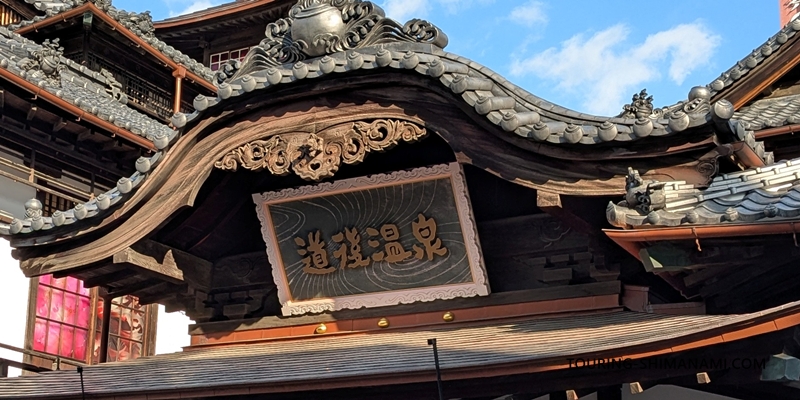
Today, there are three public bathhouses in Dogo Onsen where visitors can enjoy a day-use bath. They are Dogo Onsen Honkan, Asuka-no-Yu, and Tsubaki-no-Yu. All three use water from the same hot spring source, but their atmosphere, prices, and concepts are quite different. Many visitors find themselves wondering, “Which one should I try?” or “Should I visit them all?”
- Which bathhouses in Dogo Onsen offer day-use bathing?
- What kind of hot spring resort is Dogo Onsen?
- The differences and unique features of the three bathhouses
On this page, I’ll introduce the characteristics and differences of the three public bathhouses in Dogo Onsen, based on my many visits as someone who loves hot springs. I’ll also explain what kind of travelers each one might suit best. Whether it’s your first time visiting Dogo Onsen or you’ve been there before, I hope this guide will help you decide where to go.


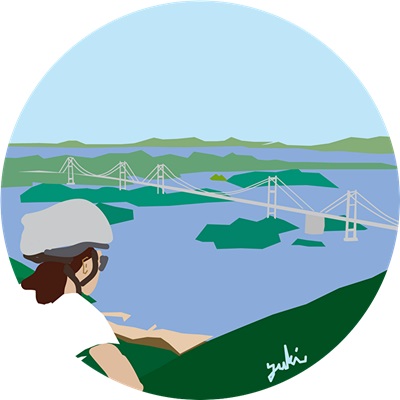
The Shimanami Kaido cycling route and Dogo Onsen in Matsuyama make a perfect combination!
AD (Google AdSense)
What kind of hot spring is Dogo Onsen?
One of Japan’s oldest hot springs, with about 3,000 years of history
Dogo Onsen is said to have around 3,000 years of history, and its name is believed to appear in the ancient Japanese chronicle Nihon Shoki. It is often listed alongside Arima Onsen and Shirahama Onsen as one of the “Three Oldest Hot Springs in Japan.” Ehime Prefecture was historically called “Iyo,” and one theory suggests that the name comes from ideyu, meaning “a place where hot spring water flows out.”
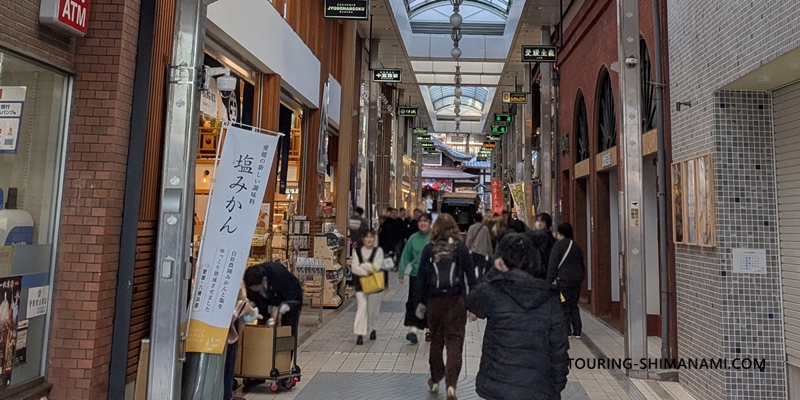
Dogo Onsen is also widely known as the setting of the famous novel Botchan by Natsume Soseki. In the hot spring district, a retro-style Botchan Train runs through the streets, and the covered shopping arcade is filled with unique local shops. You’ll find many Ehime specialties here, such as 100% mikan (mandarin orange) juice, Botchan dango sweets, Iyo-style sponge cake called “tart,” craft beer, sea bream rice, and Imabari towels. The charm of Dogo is that you can enjoy strolling around the town itself—not just the hot springs.
You can also reach Dogo Onsen easily by streetcar from central Matsuyama, which makes it simple to include in a sightseeing route around the city. It also pairs well with a visit to Matsuyama Castle, one of Japan’s few castles with an original surviving main keep, and it’s just as easy to access by streetcar. If you are traveling in Ehime Prefecture, this is definitely a place I recommend visiting at least once.
The hot spring water at Dogo Onsen
The hot spring water at Dogo Onsen is classified as an alkaline simple hot spring. It is clear and colorless with almost no smell. The water feels gentle on the skin and contains relatively mild mineral content, which is why it is often called a “beauty bath” in Japan. It is commonly said to help with neuralgia, muscle pain, and recovery from fatigue (these are typical benefits often mentioned for hot springs, but personally I feel that Dogo Onsen is especially good for relieving tired muscles!).
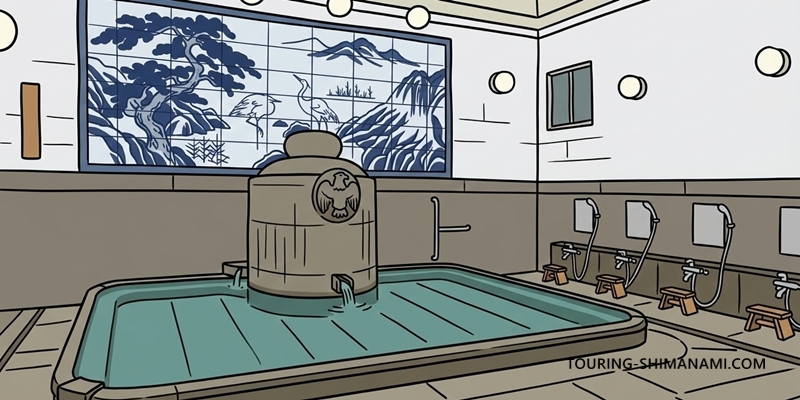
The three bathhouses—Dogo Onsen Honkan, Asuka-no-Yu, and Tsubaki-no-Yu—all use water from the same Dogo Onsen source. Since Shikoku does not have active volcanoes, it rarely produces extremely hot springs like those in Beppu in Oita Prefecture where the water can exceed 90°C. At Dogo Onsen, the source water ranges from about 20°C to 55°C. By blending several springs, the bathhouses can offer natural kakenagashi (free-flowing hot spring water without reheating or dilution), which is one of the appealing features of Dogo Onsen.
After moving your whole body on a Shimanami Kaido cycling trip, the gentle warmth of this hot spring feels just right for relaxing and recovering from the day’s ride.
The water is actually quite simple—there’s no strong sulfur smell and it isn’t cloudy or colored like some other hot springs.
AD (Google AdSense)
Comparing the three public bathhouses
Three bathhouses, each with a different character
The three public bathhouses of Dogo Onsen each have a very different personality. In simple terms, the Honkan is a “bath of history and tradition,” Asuka-no-Yu is a “bath of art and experience,” and Tsubaki-no-Yu is a “bath of everyday local life.”
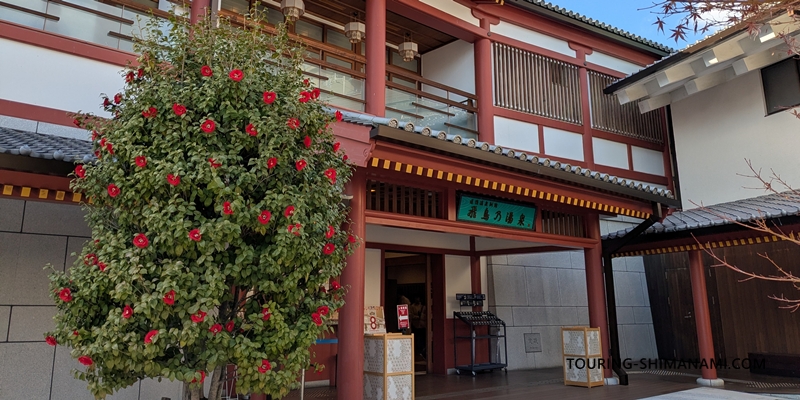
Even though they share the same hot spring source and are located in the same Dogo area, the experience of bathing in each one feels completely different. It can be fun to choose based on your travel style or interests, and if you have enough time, visiting more than one bathhouse is also a great idea. I recommend first checking the comparison table below to get a quick overview of the differences, then reading the detailed introductions of each bathhouse afterward.
| Dogo Onsen Honkan | Asuka-no-Yu | Tsubaki-no-Yu | |
|---|---|---|---|
| Atmosphere | Historic, retro, dignified | Artistic, modern, vibrant | Simple, local, relaxing |
| Building Style | Three-story wooden structure, Important Cultural Property | Inspired by the Asuka period, traditional crafts × contemporary art | White plaster walls, traditional storehouse-style design |
| Baths | Kami-no-Yu and Tama-no-Yu (indoor baths only) | Large indoor bath + semi-open-air bath | Indoor bath only (simple) |
| Rest Areas | Tatami rooms on the 2nd–3rd floors, some private rooms | Large hall, private rooms, special bath rooms | Benches in the lobby only |
| Admission Fee (approx.) | From about ¥700 (varies by plan) | From about ¥600 (varies by plan) | Around ¥450 (flat rate) |
| Recommended For | First-time visitors to Dogo / history & architecture lovers | Friends’ trips, couples, art lovers | Budget travelers / those who want to experience local culture |
*Prices may change. Please check the official website of each facility for the latest information.
AD (Google AdSense)
① Dogo Onsen Honkan
One of Japan’s oldest baths, inside an active Important Cultural Property
Dogo Onsen Honkan is a wooden three-story bathhouse built in 1894. It was the first public bathhouse in Japan to be designated an Important Cultural Property while still operating, and its historical significance is truly unique. The distinctive exterior, designed by master temple and castle carpenter Matahachiro Sakamoto, features a tower-like structure that has become the symbol of the Dogo Onsen district. Its dignified appearance during the day is beautiful, and the nighttime illumination under traditional gas lamps creates an equally atmospheric scene.
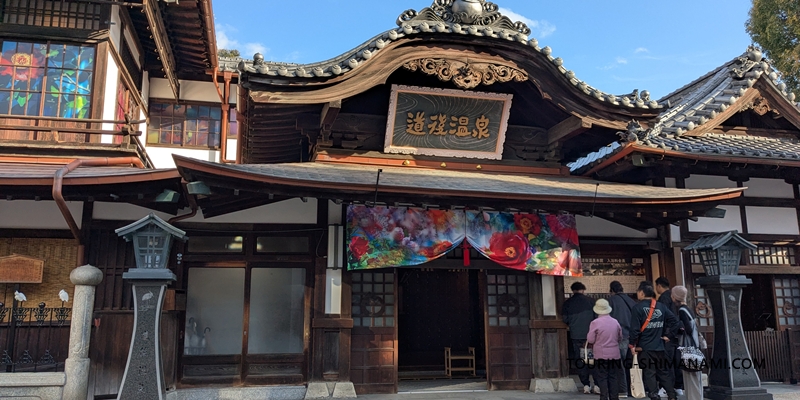
| Day-Use Bathing | Dogo Onsen Honkan |
|---|---|
| Name | Dogo Onsen Honkan (Main Building) |
| Features | A wooden three-story bathhouse built in 1894. The first operating public bathhouse in Japan designated as an Important Cultural Property. Enjoy one of Japan’s oldest hot springs with natural free-flowing water. |
| Address | 5-6 Dogo Yunomachi, Matsuyama, Ehime, Japan |
| Phone | +81-89-921-5141 |
| Approx. Admission Fee | From about ¥700 for adults (varies by plan) |
Inside the building, repeated renovations and extensions over the years have created a complex layout of narrow corridors and steep staircases. It is sometimes described as “maze-like,” and walking around the building can feel a bit like exploring (you may think you’re on the second floor, only to realize you’ve somehow reached the first!). I think this sense of discovery is part of the unique charm of the Honkan. In July 2024, a long-term preservation and seismic reinforcement project was completed, and the entire building—including the rest areas—has reopened to visitors. Thanks to the careful restoration, the facilities are now more comfortable to use while still preserving their historic character.
Two types of baths: Kami-no-Yu and Tama-no-Yu
Dogo Onsen Honkan has two types of bath areas: Kami-no-Yu and Tama-no-Yu. Both offer natural free-flowing hot spring water, but the stone materials and overall atmosphere are slightly different. Kami-no-Yu is a larger stone bath where many visitors gather, creating the lively atmosphere that feels very much like the “classic” Dogo Onsen experience. Tama-no-Yu uses higher-grade stone and has a more refined atmosphere, allowing you to relax in a quieter and more elegant setting.
The more casual public bath. It has a nostalgic atmosphere similar to a traditional Japanese bathhouse. In the Meiji era, there were three separate baths called Bath 1, Bath 2, and Bath 3. Today, the men’s side has two bathing areas (Higashi and Hi), while the women’s side has one.
A more luxurious “special bath.” Historically it was reserved for members of the imperial family and other distinguished guests. Today it is open to the public, but it still feels a bit more refined than Kami-no-Yu. If you choose the Tama-no-Yu plan, you can also use Kami-no-Yu.
*The names also have meanings: Kami-no-Yu literally translates to “Spring of the Gods,” while Tama-no-Yu means “Spring of the Spirits.”
For each bath area, several plans are available—from simple bathing-only options to plans that include access to tatami rest rooms on the second or third floor, or even private rooms. If you would like to enjoy the classic Japanese hot spring experience of relaxing after your bath in a yukata while sipping tea and enjoying a small sweet, I highly recommend choosing a plan that includes a rest room. Prices vary depending on the plan, but as a rough guide, the Kami-no-Yu bath-only option starts at around ¥700, while plans with rest areas generally start from around ¥1,000. For details, please check the official website.
Recommended for these travelers
If it’s your first time visiting Dogo Onsen, I always recommend starting with the Honkan. When people think of Dogo Onsen, this is usually the building that comes to mind—it’s the symbolic heart of the hot spring town and the classic place to begin. It’s especially appealing for travelers who enjoy history and architecture, those interested in literary landmarks, or anyone looking for a photogenic hot spring experience.
On the other hand, because it is a historic building, there are many steep stairs and level changes, so it cannot really be considered barrier-free. If you have concerns about mobility, it may be helpful to keep this in mind before visiting.
Look for the motifs of the white heron and hot spring bubbles
At Dogo Onsen, you’ll often notice two decorative motifs: the white heron and hot spring bubbles. According to a local legend, a white heron once healed its injured leg in the hot spring here, which is said to be the origin story of Dogo Onsen. The bubble motif represents the moment when hot spring water bursts up from the source. These designs appear in many places—lighting fixtures, sliding doors, roof tiles, nail covers, and even teacups. It’s fun to keep an eye out and see how many you can spot.
Opening hours and prices (Approx.)
Opening hours are roughly from 6:00 a.m. to 10:00 p.m., although the final admission time varies depending on the plan and the season. Being able to enjoy an early morning bath is also a nice feature for travelers. Several bathing plans are available, but for the most accurate information on prices and reception hours, please check the official Dogo Onsen website. If you decide on a plan before visiting, the reception process will usually go more smoothly.
If it’s your first visit, I’d recommend choosing a plan that includes a rest area rather than just the basic Kami-no-Yu bath.
AD (Google AdSense)
② Dogo Onsen Annex: Asuka-no-Yu
A modern bathhouse inspired by the Asuka period
Opened in 2017, the “Annex Asuka-no-Yu” is a newer bathhouse themed around the historical accounts of Prince Shotoku and Empress Saimei visiting Dogo Onsen. The building incorporates architectural elements from the Asuka period, creating a very different atmosphere from the “classic retro feel” of the Main Building. Instead, visitors will find a refined artistic space throughout the facility. Traditional crafts representing Ehime—such as Iyo Kasuri textiles, Tobe ware pottery, and Kikuma roof tiles—are used extensively inside, combined with projection mapping and contemporary art installations. The result is a space where you can soak in a hot spring while feeling as if you’re visiting an art museum.
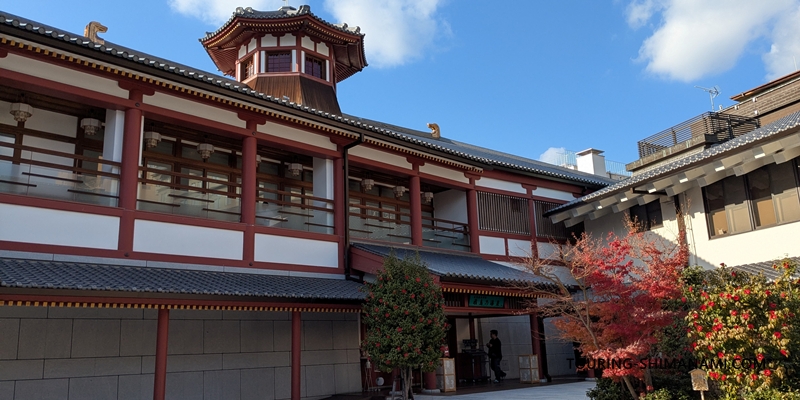
| Day-use Hot Spring | Dogo Onsen Annex: Asuka-no-Yu |
|---|---|
| Name | Dogo Onsen Annex: Asuka-no-Yu |
| Key Feature | A modern bathhouse opened in 2017. The newest public bath in Dogo, blending Ehime’s traditional crafts with contemporary art under a theme inspired by the Asuka period. |
| Address | 19-22 Dogo Yunomachi, Matsuyama City, Ehime |
| Phone Number | +81-89-932-1126 |
| Approx. Bathing Fee | Adults from around 610 yen (varies depending on the plan) |
Another major attraction of Asuka-no-Yu is its semi-open-air bath, which the main building does not have. In the outdoor bathing area, the walls are decorated with lantern-style lighting made from locally produced Hime cypress and Kikuma roof tiles, creating an atmosphere inspired by the world of the Manyoshu poetry anthology. Relaxing in the hot water while feeling the fresh outdoor air is a special experience. Also, the baths here are slightly larger than those in the main building.
A special bathing experience wearing a “Yucho” robe
Asuka-no-Yu also has two Special Bathing Rooms on the second floor. In this unique experience, guests bathe while wearing a special robe called a “Yucho,” a style of bathing garment that was historically worn by people of high status. This is a rare experience available only here. The bath itself recreates the imperial bathing room known as “Yushinden,” and the experience is sometimes described as “ceremonial.” The sense of stepping into something far removed from everyday life is the greatest appeal of this plan. It is especially popular for anniversary trips or as a special treat during a journey.
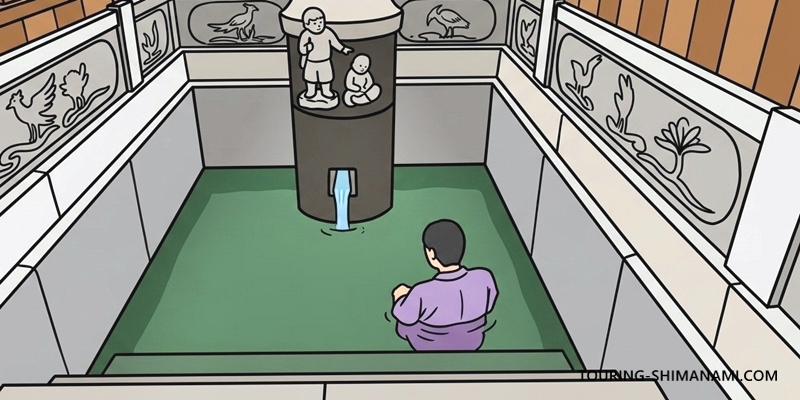
Yucho is a loose-fitting robe resembling a short kimono, worn while bathing. Unlike a regular yukata (the cotton robe often worn after bathing at Japanese inns), the Yucho is designed to be worn in the water itself—making it a truly rare and unique bathing experience.
A special bath that recreates the Yushinden bath found in the main building (Honkan). Guests can experience bathing while wearing a traditional Yucho robe. The number of participants allowed per day is limited.
A plan that allows you to relax in a private room on the second floor after bathing on the first floor. There are five rooms, each decorated with traditional crafts such as Saijo danjiri festival motifs, Sakurai lacquerware, and Imabari towels.
*The authentic “Yushinden” in the main building can only be viewed and cannot be used for bathing.
The price consists of a room usage fee plus the bathing fee, so it is slightly higher than other plans. Please check the official website for the latest prices. As a unique and memorable experience, it’s definitely worth trying at least once.
Recommended for these travelers
Among Dogo Onsen’s public bathhouses, Asuka-no-Yu has the strongest impression of being “stylish and modern,” making it especially popular with women travelers, couples, and groups of friends. It’s an ideal place for those who want to enjoy both hot springs and design or art at the same time. The facilities are also more modern and user-friendly than the main building, with better accessibility and barrier-free considerations. This makes it a comfortable option for visitors who may be concerned about the steep stairs in the main building.
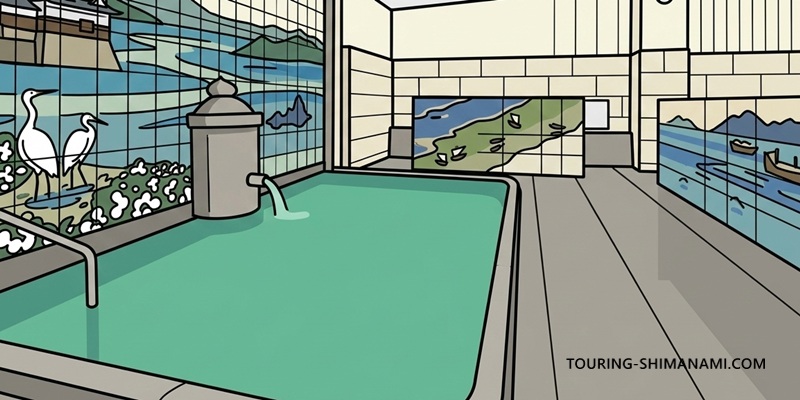
By visiting both the Main Building and Asuka-no-Yu, you can experience the “two different faces” of Dogo Onsen. If your schedule allows, it’s definitely worth trying both.
Opening Hours and Prices (Approx.)
Opening hours are generally from around 6:00 a.m. to 10:00 p.m., although the final admission time varies depending on the plan. The simplest course, which includes bathing only, typically starts in the 600-yen range. Plans that include access to a large tatami rest hall or a private rest room usually start from around 1,000 yen. The Special Bathing Room requires an additional room usage fee. For the latest details, please check the official website.
It’s very clean, and the bath itself is larger than the one in the Main Building, so Asuka-no-Yu is actually my personal favorite.
AD (Google AdSense)
③ Dogo Onsen Tsubaki-no-Yu
A simple public bath loved by locals
Located near the center of the Dogo Shopping Arcade, Tsubaki-no-Yu is a public bathhouse built in 1953 as a “sister bath” to the Dogo Onsen Main Building. After several renovations and upgrades, the current building was renewed in 2017. Unlike the other facilities, it does not offer tourist-oriented plans or relaxation services—just a straightforward indoor bath. Many local residents use it regularly, and the official Matsuyama City website even describes it as a “beloved bath for citizens.” For travelers, visiting here offers a chance to experience everyday local life rather than a typical tourist attraction.
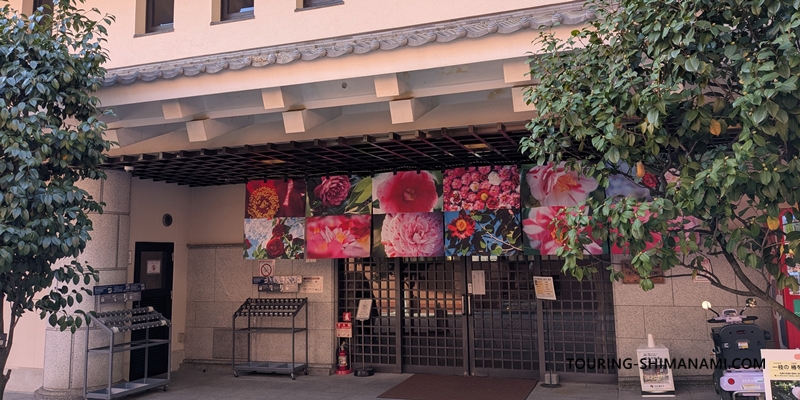
| Day-use Bath | Dogo Onsen Tsubaki-no-Yu |
|---|---|
| Name | Dogo Onsen Tsubaki-no-Yu |
| Key Feature | Founded in 1953 as a sister bath to the main building. A simple, affordable hot spring loved by local residents, offering straightforward flowing natural hot spring water. |
| Address | 19-22 Dogo Yunomachi, Matsuyama City, Ehime |
| Phone Number | +81-89-935-6586 |
| Approx. Bathing Fee | Adults around 450 yen (prices may change) |
The bathing area uses the same granite as the main building, and at the center stands a large hot water outlet called a “Yugama.” The bathhouse has a high ceiling and an open, airy atmosphere. As a subtle literary touch, haiku by the poet Masaoka Shiki are engraved on the Yugama in both the men’s and women’s baths.
Simple and casual, yet flowing natural hot spring water
The greatest appeal of Tsubaki-no-Yu is its simplicity and affordability. The bathing fee is about 450 yen for adults, making it the most budget-friendly of the three facilities and easy to drop by for a quick soak. The water quality is the same as the Main Building and Asuka-no-Yu—an alkaline simple hot spring that flows directly from the source. Compared with the often busy Main Building and Asuka-no-Yu, it is usually quieter, making it a good choice for those who simply want to relax in the hot spring itself. It’s also a great place to stop for a quick bath at the end of a stroll through the Dogo Onsen area.
It’s not uncommon for repeat visitors who have already experienced the Main Building and Asuka-no-Yu to say that they like the simple atmosphere of Tsubaki-no-Yu the most. It may not be flashy, but its relaxed and comfortable vibe is exactly what makes this bathhouse special.
Recommended for these travelers
This bathhouse is ideal for travelers who want a quick and affordable soak, those who want to experience the everyday atmosphere of local life, or visitors who only have a short amount of time between sightseeing stops. Personally, I also recommend visiting it as the final stop when hopping between the different baths. Because the facilities are simple and consist only of an indoor bath, those looking for a more luxurious hot spring experience or a place to relax for a long time may find it a bit basic. It’s best to choose based on the kind of experience you’re looking for.
Opening hours and prices (Approx.)
Opening hours are from 6:30 a.m. to 11:00 p.m. (last admission at 10:30 p.m.). Among the three facilities, it stays open the latest, making it a convenient option for a relaxing bath after dinner. The bathing fee is 450 yen for adults and 150 yen for children.
Even when Honkan or Asuka-no-Yu are crowded, Tsubaki-no-Yu is usually a bit quieter.
AD (Google AdSense)
Frequently asked questions about Dogo Onsen
- QWhich bathhouse should I try first if it’s my first visit?
- A
If it’s your first time visiting Dogo Onsen, I recommend starting with the Main Building. Soaking in a bath inside a nationally designated Important Cultural Property is a unique experience that you can only have here. If you have enough time, you can also continue on to Asuka-no-Yu or Tsubaki-no-Yu afterward. Each bathhouse offers a completely different atmosphere, which makes bath-hopping especially enjoyable.
(Bath-hopping means visiting multiple bathhouses one after another during a single trip—similar to the concept of “bar-hopping” in Western cultures. In Japan, this is a popular way to enjoy hot spring towns, and Dogo Onsen is one of the best places to experience it, since three distinct bathhouses are all within easy walking distance of each other.)
- QWhat are the basic onsen rules?
- A
Using a Japanese hot spring for the first time can feel a little unfamiliar, but the basic rules are simple. Before entering the bath, wash and rinse your body thoroughly at the shower area. Most onsen are enjoyed nude, so swimsuits are not worn. Small towels can be brought into the bathing area, but they should not be placed in the bath water.
It is also considered good manners to keep voices low, avoid splashing, and relax quietly while soaking. Tattoos may be restricted at some facilities, although policies vary, so it’s a good idea to check in advance. If you are unsure about anything, the staff are usually happy to help.
Once you know these simple customs, visiting an onsen becomes a relaxing and enjoyable cultural experience.
- QHow do I get there from the Shimanami Kaido?
- A
From Imabari City, the Ehime-side gateway to the Shimanami Kaido, it takes about one hour by car to reach Dogo Onsen. From JR Imabari Station, the limited express train to Matsuyama Station takes about 35 minutes. From central Matsuyama, you can then reach Dogo Onsen by tram (Matsuyama City Tram) in about 20 minutes. The transfers are smooth even when using only public transportation, making it an enjoyable train journey as well. It’s a great place to add to your itinerary after cycling the Shimanami Kaido.
- QIs it possible to visit all three bathhouses?
- A
Yes. All three bathhouses are within walking distance of each other in the Dogo Onsen area, so it’s very possible to visit them all in one trip. If you choose the simple bathing-only plan, about 30–60 minutes per facility is usually enough. If you plan to relax in a rest room or lounge, you may want to allow 1–2 hours per bathhouse. To fully enjoy all three at a relaxed pace, setting aside half a day to a full day is recommended.
- QDo I need to bring my own towel?
- A
At the Main Building and Asuka-no-Yu, some bathing plans include towel and yukata rentals. At Tsubaki-no-Yu, bringing your own towel is generally expected, although towels can also be purchased at the shop if needed. In some cases shampoo and body soap may not be provided, so if that concerns you, it’s a good idea to bring a small travel set. For the most up-to-date details, please check the official websites of each facility in advance.
- QIs the hot spring water at Dogo Onsen strong or harsh?
- A
The hot spring water at Dogo Onsen is an alkaline simple spring. It is colorless, clear, and odorless, and has a very gentle feel on the skin, which is why it is sometimes called a “beauty bath.” Because the water is mild and not highly stimulating, it is generally comfortable even for people with sensitive skin, those who are new to hot springs, and children. It’s also a pleasantly soothing bath after using your whole body on a Shimanami Kaido cycling trip.
- QWhat else can I enjoy besides the hot springs?
- A
The Dogo Onsen area offers many attractions beyond the hot springs themselves. You can ride the nostalgic Botchan Train, visit places connected to the writers Natsume Soseki and Masaoka Shiki, or stroll through the Dogo Shopping Arcade lined with unique souvenir shops. Taking a ride in a traditional rickshaw is also a fun option. The area is known for local specialties such as citrus-based sweets and tai-meshi (sea bream rice). Rather than just stopping for a bath, try taking your time to explore the entire neighborhood.
AD (Google AdSense)
Recommended bathing facilities outside the Dogo Area
In addition to Dogo Onsen, there are several other great bathing facilities around Matsuyama. These are especially appealing for sauna lovers or travelers who want to relax at a modern “super sento”-style bath complex.
Kisuke no Yu
This urban-style natural hot spring facility is located just a short walk from JR Matsuyama Station. It’s particularly convenient for travelers arriving by overnight bus or train, and the early opening time of 5:00 a.m. is a big plus. The natural hot spring water, drawn from about 1,700 meters underground, is a weakly radioactive sodium chloride spring known for its strong heat-retention properties, helping the body stay warm for longer. The facility features a variety of baths including indoor baths, open-air baths, carbonated baths, and pot-shaped baths. Sauna enthusiasts especially appreciate the well-equipped sauna area, which includes two types of high-temperature saunas and an ultra-cold plunge bath on the men’s side. The women’s sauna area has also been recently renovated. If you enjoy saunas, this is definitely a place worth visiting.
| Hot Springs in Matsuyama | Iyo no Tojiba Kisuke no Yu |
|---|---|
| Facility Name | Iyo no Tojiba Kisuke no Yu |
| Address | Kisuke BOX 1F, 4 Miyatacho, Matsuyama, Ehime |
| Phone Number | 089-998-3300 |
| Highlights | A natural hot spring just one minute from JR Matsuyama Station. A highly ranked sauna facility in the Nifty Onsen sauna rankings. Opens from 5 a.m., making it very convenient for train and bus travelers. |
The bathing fee is typically around 1,000 yen. The bedrock bath (ganbanyoku) area requires an additional fee. Please check the official website for the most up-to-date details. There is also a sister facility called “Shimanami Onsen Kisuke no Yu” near Imabari Station, so be careful not to confuse the two when looking up information.
Sora to Mori
Sora to Mori is a large hot spring complex offering natural baths, open-air baths, bedrock baths, saunas, private baths, and even accommodation. It’s a great option for families or groups who want to relax and spend a longer time at the facility. The location is also relatively easy to access from central Matsuyama—just a short walk from Kume Station on the Iyotetsu Railway. The restaurant serves local specialties such as Ehime-style tai-meshi (sea bream rice), and you can also enjoy craft beers from breweries around Shikoku. It’s an excellent place to combine bathing with a leisurely meal.
Teiregi no Yu
Teiregi no Yu is a bathing facility using mineral-rich natural hot spring water that flows from about 1,200 meters underground. One of its biggest attractions is the variety of baths, with around 15 different types available. The facility is also known for its excellent value, featuring nine free massage chairs for guests. After its renovation in 2019, it has become increasingly popular with younger travelers as well. Because it is located near the Shikoku 88 Temple Pilgrimage route, it is also a well-known stop for pilgrims.
| Hot Springs in Matsuyama | Higashi-Dogo Sora to Mori | Minami-Dogo Onsen Teiregi no Yu |
|---|---|---|
| Facility Name | Higashi-Dogo Sora to Mori | Minami-Dogo Onsen Teiregi no Yu |
| Address | 3-1 Minamikumemachi, Matsuyama, Ehime | 853 Nakanocho Ko, Matsuyama, Ehime |
| Phone Number | 089-970-1026 | 089-963-3535 |
| Price Range | 1,000–2,000 yen | 600–1,000 yen |
| Highlights | A stay-style hot spring complex with pH 9.2 “beauty water,” bedrock baths, and accommodation. Great for families or relaxing group trips. | A rare natural spring that flows from 1,200 m underground. Features 15 types of baths and nine free massage chairs—excellent value. |
AD (Google AdSense)
Enjoy Dogo Onsen and the Shimanami Kaido
After visiting many times myself, I feel that the true charm of Dogo Onsen lies in its deep history and long-standing hot spring culture. The three public bathhouses of Dogo Onsen each have their own unique character and atmosphere. Rather than trying to choose which one is “the best,” it’s more enjoyable to pick the one that fits your travel style and interests. For a first visit, you might start at the Main Building to experience the classic atmosphere of Dogo Onsen, then enjoy the modern artistic touches of Asuka-no-Yu, and finally finish with a simple, refreshing soak at Tsubaki-no-Yu. A bath-hopping experience like this is one of the unique pleasures of visiting Dogo.
If you are cycling along the Shimanami Kaido, consider combining your trip with a visit to Dogo Onsen and enjoy the nature, culture, and hot springs that Ehime has to offer.
This page introduced the three main day-use bathing facilities of Dogo Onsen in Matsuyama, Ehime Prefecture. One of the best things about the Shimanami Kaido is that it’s not too far from Dogo Onsen, and even beginners can enjoy cycling there comfortably. If you would like to learn more about cycling the Shimanami Kaido, please check the detailed guide linked below.