
From Oct 1, 2026, the Imabari–Fukuyama Shimanami Liner bus will move to a reservation system. I look at the new fares and what it means for cyclists and rental bike trips.
Hi, I’m Yuki KAWAI — a touring cyclist based along the Shimanami Kaido. Having cycled this route more than 300 times, I created this site to share practical, experience-based tips for anyone planning a cycling trip here. I hope it helps you make the most of one of Japan’s most beloved cycling destinations.
The Shimanami Liner Is Moving to a Reservation System
The highway bus “Shimanami Liner,” which is commonly used for getting around the Shimanami Kaido area, has an announcement worth knowing about: from October 1, 2026, the Imabari–Fukuyama route will switch to a reservation system. Until now, this route has been a walk-up service with no advance booking, but going forward it seems riders will be able to secure a seat ahead of time.
![[Photo] The Shimanami Liner is a bus route that offers views of the Shimanami Kaido.](https://touring-shimanami.com/wp-content/uploads/2026/08/ima-fukuyama-bus-1.jpg)
The Shimanami Liner isn’t just used by locals — it’s also a route that a lot of cyclists rely on when touring the Shimanami Kaido by rental bike. In this article, I’d like to go over the details of this news and think through what it might mean for anyone planning a rental bike trip.
A highway bus route connecting Imabari City in Ehime Prefecture and Fukuyama City in Hiroshima Prefecture. It runs along the Shimanami Kaido expressway and stops at several of the islands along the way, so it’s also frequently used by cyclists on rental bikes. JR Fukuyama Station is a hub station in eastern Hiroshima Prefecture served by the Shinkansen, which makes it a convenient connection point too.
For the basics on the Imabari–Fukuyama “Shimanami Liner” — which stops it makes and how it’s typically used for cycling trips — I’ve put together the background information on this page.

What Changes From October 2026
On August 21, 2026, the four operating companies — Setouchi Unyu, Setouchi Shimanami Leading, Chugoku Bus, and Tomotetsu — announced changes to the “Shimanami Liner” (Imabari–Fukuyama route) highway bus. The news was published on each company’s website, through PR TIMES, and in local newspapers.
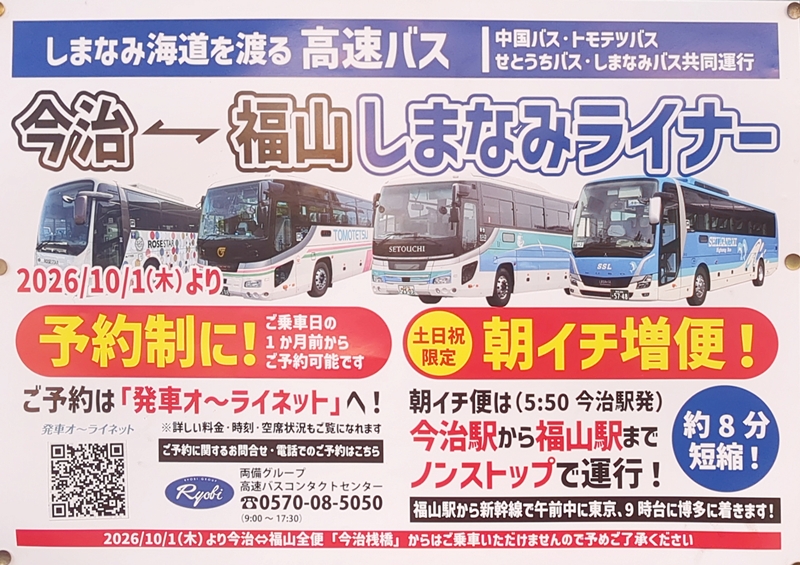
From Thursday, October 1, 2026, this route, which previously had no reservation option, will move to an all-seats-reserved system. Reservations will reportedly open one month before the travel date.
It’s worth noting that there’s another “Shimanami Liner” — the Imabari–Hiroshima route — which has been fully reservation-based for some time already and isn’t affected by this news. The two routes share the same name, which can be a little confusing, but this article is specifically about the Imabari–Fukuyama route, the one most often used for Shimanami Kaido cycling trips.
Behind the Change: Sold-Out Seats in Peak Season
Until now, the Imabari–Fukuyama Shimanami Liner couldn’t be booked in advance, so during busy periods the bus you’d planned to catch could sometimes fill up completely. In cases where there was genuinely no room, riders were apparently directed to the next available service.
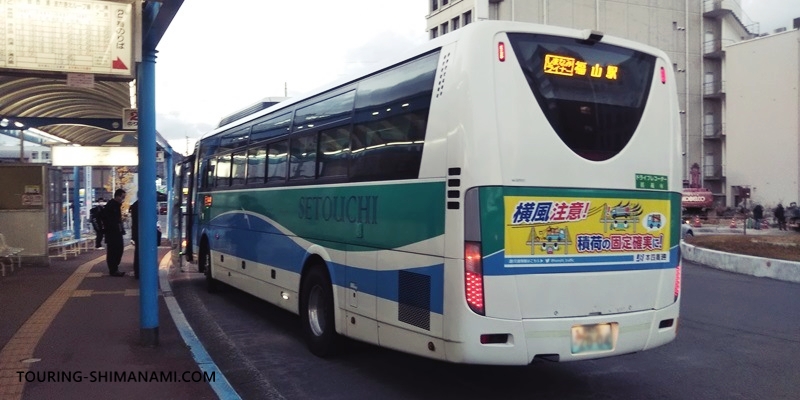
JR Fukuyama Station is served by the Shinkansen and functions as a central terminal for this part of the region. The route is used not only by travelers but also by people heading home to visit family, so demand tends to concentrate around Golden Week, Obon*, and the New Year holidays in particular.
*A traditional Japanese Buddhist custom to honor the spirits of one’s ancestors, usually held in mid-August.
There’s also a practical reason behind it: because this bus runs on the expressway, standing passengers aren’t allowed the way they might be on a regular local bus, so capacity is limited strictly to the number of seats. It seems the goal of the new reservation system is to remove the uncertainty of not knowing whether you’ll actually be able to board on the day, by letting riders secure a seat ahead of time.
If seats are available, it sounds like walk-up boarding without a reservation will still be possible, the same as before — which I think is a bit reassuring.

It’s a relief that a reservation isn’t strictly required to board — you can still ride if there’s an open seat.
AD (Google AdSense)
The Impact on Cycling Trips, and My Take
Outside Peak Season, the Impact Feels Fairly Limited
I use this route myself fairly often, and so far I haven’t run into a fully booked bus on an ordinary weekday outside of the busy holiday periods. Since walk-up boarding is still possible when seats are open, I don’t think there’s a strong need to be too anxious about reservations if your cycling trip falls outside peak season.
![[Photo] Empty seats are sometimes noticeable on the Shimanami Liner during weekday daytime hours.](https://touring-shimanami.com/wp-content/uploads/2026/08/imabari-fukuyama-bus.jpg)
To be honest, my first reaction on hearing that this route was moving to reservations was that it would be inconvenient if it meant you absolutely couldn’t board without booking ahead. So the fact that walk-up boarding is still allowed when there’s space makes a real difference. Going forward, I’ll probably still skip the reservation myself whenever I’m not sure which bus I’ll end up catching.
That said, for anyone visiting the Shimanami Kaido for the first time, simply not knowing whether you’ll be able to board can be a source of worry on its own. If that’s a concern for you, checking seat availability and booking with some room to spare is probably the safer choice.
A Little More Planning for Buses After Your Bike Return
This bus route is often used for the return leg of a one-way cycling trip, or for plans that only cover part of the islands. A common pattern is returning your rental bike at a terminal partway along the route, then continuing on toward Imabari or Fukuyama (Onomichi) by Shimanami Liner. A couple of examples:
- Onomichi Station → [cycling] → Imabari Station (bike return) → [Shimanami Liner] → Fukuyama Station
- Imabari Station → [cycling] → Kamiura, Omishima Island (bike return) → Omishima Bus Stop → [Shimanami Liner] → Fukuyama Station
In this kind of plan, it can be hard to know in advance exactly what time you’ll reach the terminal, since that depends on how the ride itself goes — which can make an early reservation tricky. Reservations reportedly stay open until 10 minutes before departure from the bus’s starting terminal (like Imabari Station). This means if you are boarding midway, such as at Omishima, reservations will close well before the bus actually reaches your stop. Therefore, if you’re planning to use the Shimanami Liner after returning a rental bike, it’s probably a good idea to check seat availability on your phone partway through the ride, or toward the end.
The effect seems most noticeable in peak season, when you don’t yet know exactly which bus, or which stop, you’ll be catching.
AD (Google AdSense)
Tips for a Smoother Trip
Planning the Bus Ride First
If you’d like to lock in your Shimanami Liner seat with certainty during busy periods, one option is to flip the order of your trip: take the bus to your starting point first, then rent a bike and begin cycling from there.
- Fukuyama Station → [Shimanami Liner] → Imabari Station → [cycling] → Onomichi Station (bike return)
- Fukuyama Station → [Shimanami Liner] → Omishima Bus Stop → Kamiura, Omishima Island → [cycling] → Onomichi Station (bike return)
With this approach, your bus departure time is fixed well in advance, which makes reserving ahead much easier. If you also book your rental bike around your bus’s arrival time, you should be able to start cycling smoothly once you reach the island.
Using Online Reservations and the Discount Fare
Reservations for the Shimanami Liner can reportedly be made through the online booking service “Japan Bus Online (Hassya O’right Net),” by phone through the Ryobi Group Highway Bus Contact Center, or in person at Setouchi Bus counters.
![[Photo] Reservations can also be made at bus ticket centers, such as the one in front of Imabari Station.](https://touring-shimanami.com/wp-content/uploads/2026/08/ima-fukuyama-bus-2.jpg)
Since bookings open one month before the travel date, anyone planning to use this route during a busy period might want to check availability early.
- Online booking: Japan Bus Online
- Phone booking: Ryobi Group Highway Bus Contact Center (9:00 AM–5:30 PM)
- In-person booking: Setouchi Bus (Setouchi Unyu) counters
Fares are also being revised alongside the move to reservations. For example, the adult fare from Imabari Station to Fukuyama Station is going up from ¥2,800 to ¥3,300 — an increase of around ¥500. On the other hand, paying online through Japan Bus Online qualifies you for a discounted “online payment fare” of ¥2,970, roughly 10% off the regular fare. If you’d like to keep your travel costs down a little, it’s probably worth taking advantage of that.
There have been small fare increases before, but this one is a fairly noticeable jump.
AD (Google AdSense)
Planning at Your Own Pace
A Note for Anyone Planning Rinko (Bagged Bike Transport)
Some travelers prefer to bring their own bicycle rather than using a rental, transporting it between Imabari and Fukuyama on the Shimanami Liner as “rinko” — the common Japanese practice of disassembling and bagging a bike to carry it on public transport. As of now, a bagged bike can be loaded into the trunk when there’s room, and there’s signage confirming this at the bus terminal in front of Imabari Station.
Whether the same arrangement will continue once the reservation system starts in October hasn’t been announced yet, as far as I can tell.
A Few More Changes Worth Checking Before You Go
On top of the reservation system, a new “early morning direct” bus is being added from October 3, 2026, running Saturdays, Sundays, and holidays only. It’s scheduled to leave Imabari Station at 5:50 AM and arrive at Fukuyama Station at 7:10 AM, timed with a connection to the Sanyo Shinkansen in mind.
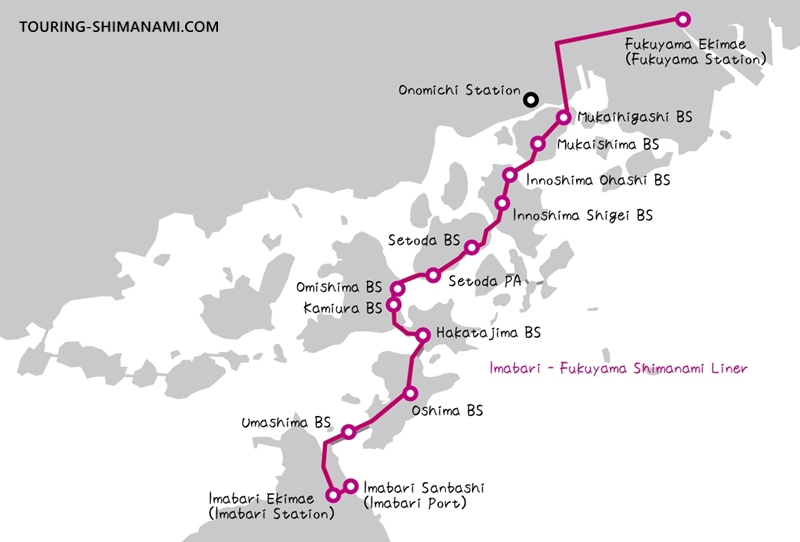
With the Imabari-side departure point being consolidated at Imabari Station, the bus will no longer stop at the “Imabari Sanbashi” (Imabari Port) stop it used to serve. Since most cyclists touring the Shimanami Kaido tend to use Imabari Station anyway, I’d expect the impact of that particular change to be fairly small.
That covers what I know so far about the Shimanami Liner’s move to a reservation system. Booking a bus in advance might sound like an extra hassle, but once you’ve got the key points in mind, it isn’t really that complicated. I hope that even while getting properly prepared, you’ll still leave room for a few unplanned detours along the way, and enjoy your Shimanami Kaido cycling trip at your own pace.
This page covered the news of the Shimanami Liner’s new reservation system and what it might mean for your trip. On my website, Shimanami Bike Touring Tips, I’ve put together information to help even first-time visitors enjoy Shimanami Kaido cycling with confidence.