
![[Title] Surprisingly Recommended? The Benefits and Things to Know About Winter Cycling on the Shimanami Kaido](https://touring-shimanami.com/wp-content/uploads/2025/12/wintere-ogp.png)
Is cycling the Shimanami Kaido okay in winter? This page summarizes the benefits, things to watch out for, and practical tips unique to cycling trips during the colder months from December to February, including shorter daylight hours.
Hi, I’m Kawai — a touring cyclist based along the Shimanami Kaido. Having cycled this route more than 300 times, I created this site to share practical, experience-based tips for anyone planning a cycling trip here. I hope it helps you make the most of one of Japan’s most beloved cycling destinations.
Shimanami Kaido, Japan
A rapid increase in first-time visitors
The Shimanami Kaido is one of the bridge routes connecting Honshu and Shikoku, linking Onomichi City in Hiroshima Prefecture with Imabari City in Ehime Prefecture. This scenic area is made up of a chain of beautiful islands. What makes sightseeing on the Shimanami Kaido truly unique is traveling by bicycle. The bridges connecting the islands are designed not only for expressway traffic, but also so that cyclists can cross them safely, making this route one of Japan’s most famous cycling destinations.
![[Photo] Winter on the Shimanami Kaido: Cyclists crossing the Kurushima Kaikyo Bridge](https://touring-shimanami.com/wp-content/uploads/2025/12/wintershima-5.jpg)
In the past, most visitors to the Shimanami Kaido were experienced cyclists who regularly rode road bikes or other sports bicycles. In recent years, however, improvements such as flexible rental cycle systems and the blue line road markings that guide cyclists along the route have made it much easier for beginners to enjoy a cycling trip. As a result, the number of travelers visiting the area for their very first long-distance cycling experience has increased rapidly.
![[Illustration] Cycling the Shimanami Kaido: A sample course for crossing the route in two days](https://touring-shimanami.com/wp-content/uploads/2025/06/2daysbestplan.png)
That said, cycling across all the islands of the Shimanami Kaido still means covering a distance of about 70 kilometers at minimum. If you are planning to try long-distance cycling for the first time on the Shimanami Kaido, I recommend preparing and planning your trip based on information that matches your own experience level. On my website, I also share advice and practical suggestions for people who are visiting the Shimanami Kaido for the first time.

AD (Google AdSense)
Benefits of winter cycling
This time, I focus on the season in which you cycle the Shimanami Kaido. Winter is generally not a time when most people feel eager to ride a bicycle, but I would like to share the unique benefits, things to be aware of, and practical countermeasures that come with winter cycling. Is it too cold? Does it snow? On the Shimanami Kaido, winter cycling is actually surprisingly recommended for several reasons.
Benefit 1: Clear, crisp air
This is not unique to the Shimanami Kaido, but winter is generally said to have clearer air, making distant views more beautiful. According to the Japan Meteorological Agency, “Compared to summer, winter has lower temperatures and weaker convective activity, resulting in less water vapor and dust in the air. As a result, winter appears clearer than summer.” I feel this is true on the Shimanami Kaido as well, where mountains of the Shikoku range, including Mt. Ishizuchi, which are rarely visible in summer, often appear sharply defined in winter.
![[Photo] Winter on the Shimanami Kaido: Clear air reveals sharply defined mountain scenery](https://touring-shimanami.com/wp-content/uploads/2025/12/wintershima-2.jpg)
One of the most memorable sights along the Shimanami Kaido is the Seto Inland Sea landscape, where countless islands overlap and fade into the distance. Islands shrouded in mist or haze have their own beauty, but being able to clearly see faraway islands is a major advantage of visiting in winter. You can look forward to especially impressive views from the cycling paths on the bridges, as well as from scenic viewpoints and observation decks.
Benefit 2: Low precipitation
The Seto Inland Sea area, where the Shimanami Kaido is located, is known for its relatively mild climate and low rainfall. Even when cycling the Shimanami Kaido in winter, there is usually little need to worry about snow. In places such as Onomichi city on the Hiroshima side, a thin layer of snow may occasionally fall on very cold mornings, but it typically melts completely by daytime.
![[Graph] Average precipitation for Imabari City (created from meteorological data from the Japan Meteorological Agency)](https://touring-shimanami.com/wp-content/uploads/2025/07/prec.png)
I created this graph using publicly available data from the Japan Meteorological Agency to show precipitation levels in Imabari, one of the starting and ending points of the Shimanami Kaido. As expected, rainfall is highest in June and July during the rainy season, and again in September due to autumn rain fronts and typhoons. In contrast, from December to February, monthly precipitation is around 50 mm. This relatively dry climate means there is a lower risk of rain when cycling. From my own experience living along the Shimanami Kaido, even on winter mornings that start out cloudy, the weather often clears and becomes sunny during the day.
Benefit 3: You don’t sweat too much
Unlike summer, one major advantage of winter cycling is that you don’t sweat excessively. Compared to hot weather, it is much easier to regulate your body temperature with proper clothing in colder conditions. When cycling long distances at a relaxed pace, this often results in less physical strain. While the risks of UV exposure and heat exhaustion are not completely zero, they are significantly lower than during the peak heat of midsummer.
| Imabari (Average) | Average Temperature (°C) | Average Daily High (°C) | Average Daily Low (°C) |
|---|---|---|---|
| November | 13.0 | 17.3 | 8.9 |
| December | 8.1 | 12.2 | 4.1 |
| January | 5.9 | 9.8 | 1.8 |
| February | 6.1 | 10.3 | 1.7 |
| March | 9.0 | 13.6 | 4.3 |
| April | 13.7 | 18.8 | 8.8 |
According to an academic study on full marathons, the optimal temperature for a male runner aiming for a 3-hour-30-minute finish is around 6°C. The same logic applies to slow cycling, which is also an endurance-based aerobic activity: cooler temperatures tend to be more comfortable than hot ones. While cycling the Shimanami Kaido is not nearly as intense, single-digit temperatures can feel a bit too cold (especially in January). However, temperatures around 10–15°C are often surprisingly comfortable for cycling.
Benefit 4: Fewer travelers
Based on my experience cycling the Shimanami Kaido throughout the year, the number of cycling travelers clearly drops in winter. After the popular autumn travel season ends, December in Japan has no national holidays, and it becomes a busy time for work and daily life. For many Japanese people, it is a season when it is difficult to take consecutive days off, except around the New Year holidays.
![[Photo] Winter on the Shimanami Kaido: Fewer travelers during the winter season](https://touring-shimanami.com/wp-content/uploads/2025/12/wintershima-4.jpg)
Another reason is the general perception in Japan that “cycling is not a winter sport.” On cold days, most people naturally prefer to stay indoors and keep warm. To be honest, I find myself staying at home more on cold days as well. Having fewer travelers overall makes it easier to reserve rental bikes and book accommodations. There is also a higher chance of getting into popular restaurants without having to wait in long lines.
Benefit 5: Citrus fruits and seasonal local foods
When you visit the Shimanami Kaido area, I highly recommend trying the local citrus fruits, such as mandarin oranges and lemons. Ehime Prefecture, often called the “kingdom of citrus,” grows more than 40 different varieties. The harvest season varies by type, but most citrus fruits are at their best in winter. From around December, citrus begins to appear in shops, with the peak season lasting until about March. Be sure to try some varieties that are rarely found outside the region.
![[Photo] Winter on the Shimanami Kaido: Citrus fruits such as lemons are in season during winter](https://touring-shimanami.com/wp-content/uploads/2025/12/wintershima-1.jpg)
This is not limited to the Seto Inland Sea, but many kinds of seafood are also in season from winter through spring. Enjoying dishes made with fresh, locally caught seafood is another highlight of traveling along the Shimanami Kaido. Because you are visiting in winter, take the opportunity to discover and savor the region’s seasonal flavors.
So for all these reasons, winter cycling might not be such a bad idea after all.
AD (Google AdSense)
Things to know about winter cycling
As you can see, winter cycling on the Shimanami Kaido comes with several advantages, making it a unexpectedly good season to visit. At the same time, there are also some important points to keep in mind that are unique to winter cycling. If you don’t usually cycle on a regular basis, some of these considerations may not be immediately obvious.
Point 1: Early sunset
The most important thing to be aware of when cycling the Shimanami Kaido in winter is the early sunset. In Japan, sunset times vary greatly throughout the year: they are late in summer (around 7:30 p.m.) and early in winter (around 5:00 p.m.). For example, the difference in sunset time between the summer solstice and the winter solstice is about two and a half hours. Sunrise times also vary, with summer being earlier and winter later, with a maximum difference of just over two hours.
| Imabari (2025) | Sunrise | Sunset |
|---|---|---|
| Summer Solstice (June 21) | 4:56 | 19:22 |
| Winter Solstice (December 22) | 7:09 | 17:03 |
In other words, the amount of daylight can differ by nearly five hours between summer and winter. At a relaxed pace on a rental bike, you can usually cover about 10 km per hour. By simple calculation, a difference of five hours translates into roughly 50 km. This assumes starting at sunrise and finishing at sunset, but either way, the distance you can comfortably ride during daylight hours changes significantly depending on the season.
![[Photo] Winter on the Shimanami Kaido: Night views are beautiful, but cycling paths become very dark](https://touring-shimanami.com/wp-content/uploads/2023/02/yakei-shimanami.jpg)
Especially on the islands along the Shimanami Kaido, it becomes very dark after sunset, which greatly increases the risks associated with cycling at night. There is also the possibility of encountering wild animals such as wild boar, so I personally do not recommend cycling after dark at all. When planning your trip, try to arrive at your destination at least one hour before sunset to allow plenty of extra time and ride safely.
Point 2: Proper cold-weather protection
As mentioned earlier, based on my own experience, it is easier to regulate your body temperature with clothing in cold weather than in hot weather. When climbing hills or increasing your pace, your cold-weather gear may start to feel too warm. On the other hand, when riding downhill or just after starting out, your body can cool down quickly. For winter cycling, it is important to wear clothing that you can easily put on and take off.
![[Illustration] Winter on the Shimanami Kaido: Rainwear is essential for cycling in wet conditions](https://touring-shimanami.com/wp-content/uploads/2024/01/raingear-wear.png)
That said, rental bikes limit how much luggage you can carry, and it is best to keep your bags as light and compact as possible. In addition to lightweight and warm outdoor clothing, packable garments are highly recommended. Using rainwear as an extra layer for warmth can also help reduce luggage and prepare you for unexpected rain. Bringing a few extra base layers and changing only your inner layer when you sweat is another effective way to manage your body temperature.
Point 3: Unexpected dehydration
It may come as a surprise, but dehydration can still occur during winter cycling. Compared to hot summer days, the cold weather makes it harder to notice thirst, and some people end up dehydrated without realizing it. Even in winter, be mindful of drinking fluids regularly while cycling. The islands along the Shimanami Kaido have vending machines and convenience stores, so there is no need to worry about finding drinks along the way.
Point 4: Strong northerly winds
One of the factors that has a big impact on cycling, which relies entirely on human power, is the wind. When the wind is strong, it becomes resistance unless it is a tailwind, making it harder to move forward. When planning a cycling trip, it’s easy to focus only on whether the weather forecast says sunny or rainy, but I recommend also checking the forecast for wind direction and wind strength. Depending on the conditions, changing your starting point and setting your riding direction to take advantage of a tailwind can be a smart option.
![[Screenshot] Quoted from windy.com: Typical winter wind direction in the Shimanami Kaido area](https://touring-shimanami.com/wp-content/uploads/2025/12/winterwind.jpg)
In the Shimanami Kaido area, wind strength and direction can vary greatly from place to place due to the complex geography of the sea and islands. According to information from the Matsuyama Local Meteorological Office, winter winds in this region are strongly influenced by seasonal winds, and it is common for westerly to northwesterly winds to blow. When a typical winter pressure pattern forms, with high pressure to the west and low pressure to the east, cold northerly winds flow into the area, bringing stronger winds and lower temperatures. The Seto Inland Sea is known as a corridor for wind, so conditions here tend to be windier than on inland areas.
Maps you should get in advance
“CycloTourisme Shimanami,” which has been active in cycle tourism and regional promotion for nearly 20 years along the Shimanami Kaido, publishes guidebooks and maps. The map is also available in English and is extremely popular as it is the most detailed cycling-specific map in this region.
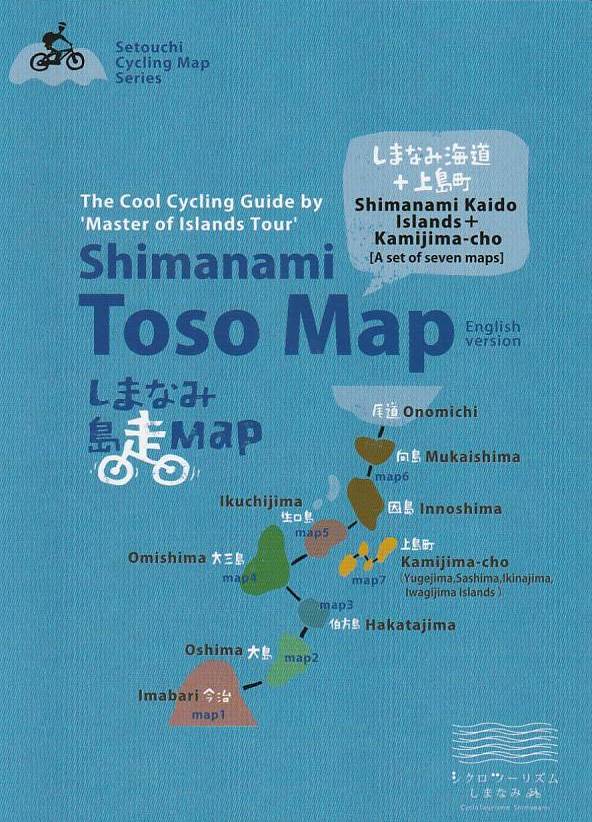
This product comes with a set of seven maps, each with a fairly detailed map for each island. I believe that getting your hands on this map will change your experience here. It can be purchased on Amazon.co.jp, and you can also buy it locally at Guesthouse CYCLONOIE in front of Imabari Station.
AD (Google AdSense)
The best season for cycling
As you can see, the Shimanami Kaido is blessed with a climate that allows you to enjoy cycling throughout the year. Each season offers different scenery and seasonal food, changing the way you experience your trip. The cycling experience itself also varies greatly depending on the season, including differences in temperature, available daylight hours based on sunrise and sunset times, and weather-related risks such as rain and wind.
![[Photo] Winter on the Shimanami Kaido: I hope you find your own best season](https://touring-shimanami.com/wp-content/uploads/2025/12/wintershima-3.jpg)
On my website, I explore which season might be the best time to cycle the Shimanami Kaido from various perspectives. If you are traveling from far away to cycle here, you probably want to choose a time with ideal weather and comfortable conditions. Since the meaning of “best” depends on what you value most during your trip, I encourage you to find your own best season and come enjoy cycling on the Shimanami Kaido.
On this page, I introduced the unique benefits and important points to consider when cycling the Shimanami Kaido in winter. One of the great attractions of the Shimanami Kaido is that it offers many different ways to enjoy cycling throughout the year, depending on the season. For those planning their first Shimanami Kaido cycling trip, I provide a detailed and comprehensive guide on the page below. I hope you will find it helpful.